
The Proven Plyometric Framework: How Middle School Athletes Build Explosive Speed in 6 Weeks
Speed separates good football players from great ones. That split-second acceleration off the line, the burst through a gap, the explosive change of direction, these moments decide games. At Boardwalk Beasts Football Club, we've seen middle school athletes transform their speed in just six weeks using our proven plyometric framework.
Here's the thing: most youth programs either skip plyometrics entirely or throw kids into adult-level drills they're not ready for. Both approaches fail. Our framework bridges that gap with age-appropriate progression that builds explosive speed safely and effectively.
Why Plyometrics Work for Middle School Athletes
Plyometric training taps into what scientists call the stretch-shortening cycle (SSC). Think of it like a rubber band, stretch it quickly, then release, and you get explosive power. Your muscles work the same way. When you land from a jump and immediately explode back up, you're storing energy in the muscle and tendon, then releasing it for maximum power output.
For middle schoolers, this is golden. Their nervous systems are still developing, making this the perfect time to build those explosive movement patterns. Unlike adults who need months to see changes, young athletes adapt incredibly fast when you give them the right stimulus.

But here's the catch, you can't just throw kids into depth jumps and hope for the best. Middle school athletes need foundational strength, proper technique, and progressive overload that matches their development. Skip these steps, and you're asking for injuries or wasted training time.
The Boardwalk Beasts 6-Week Speed Framework
Our framework isn't random. It's built on three pillars: progression, specificity, and recovery. Each week builds on the last, moving from basic movement patterns to sport-specific explosive actions that translate directly to game performance.
Week 1-2: Building the Foundation
Focus: Landing mechanics and bilateral movements
These first two weeks separate our program from everyone else's. While other programs jump straight into flashy drills, we're building bulletproof movement patterns. Athletes learn to land soft, control their bodies, and understand what "explosive" really means.
Key Exercises:
- Box step-downs (focusing on deceleration)
- Vertical jumps with 3-second holds
- Broad jumps with controlled landings
- Squat jumps with perfect form
Volume: 2 sessions per week, 50-70 total foot contacts per session
Rest periods: 2-3 minutes between sets (yes, that long: quality over quantity)
Here's what most programs miss: middle schoolers need to learn how to land before they learn how to jump. We spend serious time on deceleration because that's where injuries happen. Athletes who can't control their landing will never reach their speed potential.
Week 3-4: Adding Complexity
Focus: Single-leg power and directional changes
Now we start seeing the magic happen. Athletes who nailed the basics in weeks 1-2 are ready for unilateral training and multi-directional movements. This is where football-specific speed starts developing.

Key Exercises:
- Single-leg hops (forward, lateral, backward)
- Box jumps (starting at 12 inches, progressing to 20 inches)
- Lateral bounds with stick landings
- Medicine ball reactive catches
Volume: 80-120 total foot contacts per session
Progression markers: Athletes should land in the same spot every time, with no wobbling or loss of balance. If they can't, we scale back until they can.
The single-leg work here is crucial. Football happens on one leg: running, cutting, jumping for passes. Athletes who can't generate power unilaterally will always be limited in their speed potential.
Week 5-6: Game-Speed Application
Focus: Reactive power and sport-specific patterns
This is where everything clicks. Athletes take the movement patterns they've mastered and apply them at game speed. We're not just jumping anymore: we're creating football players.
Key Exercises:
- Depth jumps (from 16-24 inches)
- Reactive medicine ball tosses
- Bounding sequences (alternating single-leg)
- Sprint starts from various positions
Volume: 100-150 total foot contacts per session
The difference: Every exercise now mimics something that happens in football. Depth jumps teach athletes to absorb force and immediately redirect it: just like hitting the ground after a tackle and getting back up fast.
The Science Behind Our Progression
Here's what makes our framework work: we manipulate three variables: volume, intensity, and complexity: in a specific sequence. Most programs change everything at once, overwhelming the athlete's ability to adapt.
Volume progression: We start with 50 contacts per session and gradually build to 150. This gives the nervous system time to adapt without overloading growing bodies.
Intensity progression: Box heights, jump distances, and landing forces increase systematically. No random jumps in difficulty that leave athletes behind.
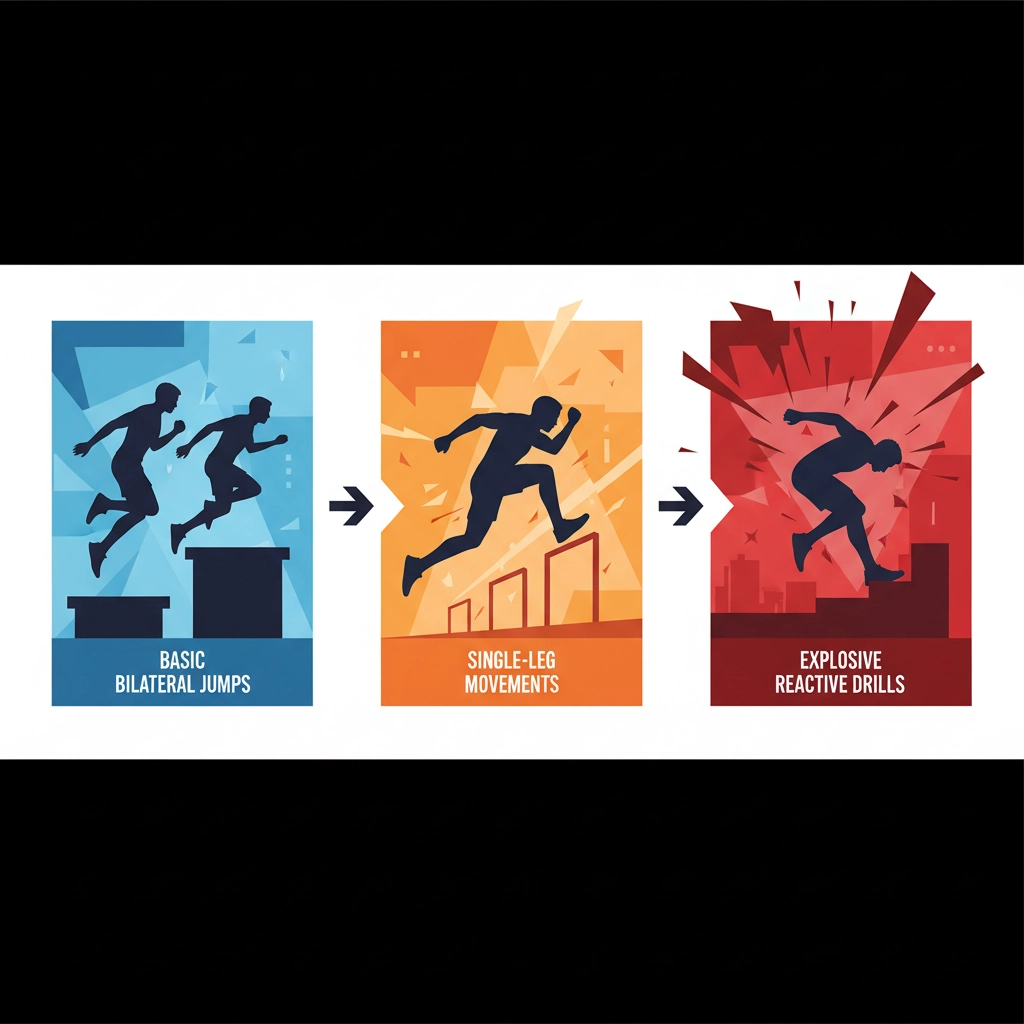
Complexity progression: Bilateral to unilateral, single-plane to multi-plane, predictable to reactive. Each step builds on the last.
Recovery protocols: Middle schoolers need different recovery than high schoolers. We use longer rest periods (2-4 minutes) and never train plyometrics on consecutive days. Quality reps, always.
What Parents and Athletes Can Expect
Week 1: Athletes learn proper form and get comfortable with the movements. Don't expect speed gains yet: we're building the foundation.
Week 2: Form becomes more natural. Athletes start understanding the connection between proper landing and explosive takeoff.
Week 3: First real improvements appear. Athletes start feeling more "bouncy" and explosive in their regular movements.
Week 4: Speed gains become noticeable in drills and scrimmages. Athletes report feeling lighter and more powerful.
Week 5: Major improvements in acceleration and change of direction. This is where coaches and parents see the real difference.
Week 6: Athletes have developed true explosive power that transfers directly to game situations.
Measurable outcomes: Most athletes see 5-10% improvements in vertical jump height, 3-5% improvements in 20-yard dash times, and significant improvements in change of direction speed.
Critical Safety Considerations
Plyometrics done wrong can sideline an athlete for months. That's why our framework emphasizes three non-negotiables:
1. Strength prerequisites: Athletes must demonstrate basic strength in squats and single-leg movements before starting plyometrics.
2. Form over everything: We never sacrifice technique for intensity. One perfect rep beats ten sloppy ones.
3. Progressive overload only: No skipping steps. Athletes earn their progression through demonstrated competency, not time served.
Red flags to watch for:
- Knee collapse during landing
- Heavy, loud landings
- Inability to stick landings consistently
- Fatigue-related form breakdown
When we see these, we regress until the athlete can perform the movement correctly.
The Boardwalk Beasts Difference
What sets our program apart isn't just the exercises: it's the coaching philosophy. We believe every athlete has explosive potential, but unlocking it requires patience, proper progression, and relentless attention to detail.
Our coaches are trained to spot movement dysfunction before it becomes a problem. We use video analysis to help athletes see their progress. We communicate constantly with parents about what they should expect and when.
Most importantly, we never rush the process. Six weeks might seem fast, but we've been refining this framework for years. Every exercise, every progression, every rest period has been tested with hundreds of middle school athletes.
Ready to Unleash Your Speed?
Speed isn't just about running fast: it's about moving with purpose, power, and precision when it matters most. Our 6-week plyometric framework gives middle school athletes the tools they need to dominate on the field.
If you're ready to see what explosive speed looks like, join us at Boardwalk Beasts. Our next training cycle starts soon, and spots fill up fast. Don't let another season pass wondering "what if."
Because at Boardwalk Beasts, we don't just build faster athletes: we build athletes who know how to use their speed to change games.
About Author