How to Play Quarterback Like Aaron Rodgers: The Throwing Techniques Every Young QB Should Master
Aaron Rodgers didn't become one of the NFL's most accurate quarterbacks by accident. His throwing motion is a masterclass in efficiency, power, and precision: qualities every young quarterback should study and adapt to their own game.
At Boardwalk Beasts, we break down elite quarterback mechanics to help our players understand what separates good from great. Rodgers' technique offers the perfect blueprint for youth quarterbacks looking to elevate their game, whether they're slinging passes in 7v7 competitions or leading their high school offense.
The Foundation: Weight Distribution and Sequencing
Everything starts with your feet and weight distribution. Rodgers emphasizes keeping your weight loaded on your back leg when your front foot hits the ground. This isn't just about balance: it's about creating the proper sequence for maximum power transfer.
Think of your throwing motion like a chain reaction. Your hips drive through first, then your elbow, and finally the ball. If you rush this sequence or start with your arm instead of your lower body, you're leaving velocity and accuracy on the table.
Young quarterbacks often make the mistake of throwing with just their arm. Rodgers shows us that the real power comes from your core and legs. When you step toward your target, imagine directing your back knee and hip toward the receiver like you're pointing flashlights in that direction.
Mastering the Deep Ball
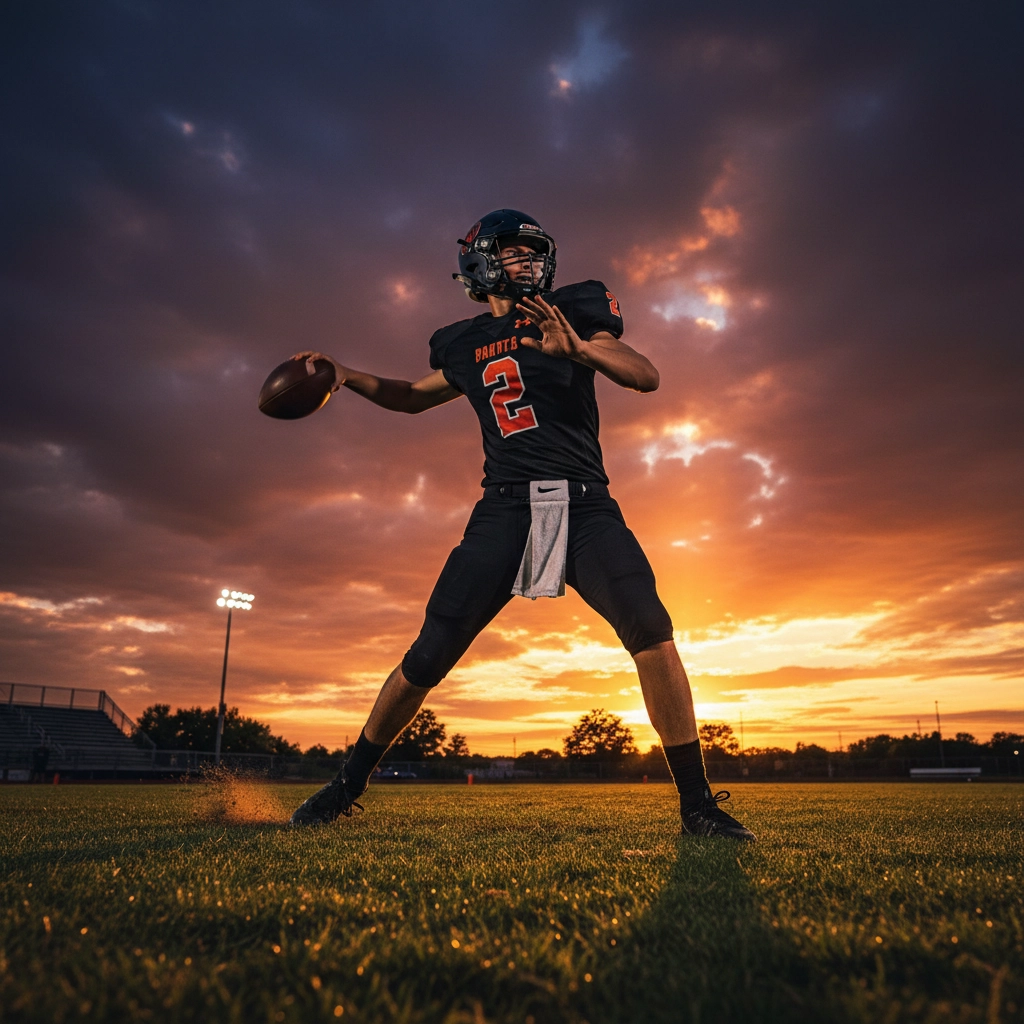
Rodgers' deep ball is legendary, and there's specific technique behind those perfect 40-yard strikes. For deep throws, you'll naturally have more weight on your back leg because you're lifting your shoulder to get arc on the ball.
The magic happens with a 45-degree shoulder angle. This position creates the energy needed to push the ball upward while maintaining accuracy. Once your front leg plants, your back hip drives through to bring your torso to about a 90-degree angle.
Here's where most young quarterbacks go wrong: they fade away like they're shooting a basketball. Rodgers rotates through with his back shoulder staying on target. Strike and hold that pose for nearly a split second on your front leg. This balance point is crucial for consistent accuracy.
The key to Rodgers' deep ball success is understanding safety alignment. If the middle safety could be a problem, throw with a lower trajectory. But in Cover 4 looks where your receiver has space on the safety, you can put more air under the ball.
The Lightning-Fast Release
Rodgers' quick release isn't just about arm speed: it's about getting your front foot down fast. The quicker you can plant that front foot, the faster your back hip can drive through and release the ball.
His famous wrist flick provides incredible release flexibility. This technique wasn't always part of his arsenal: he developed it after watching Brett Favre's improvisational style and adapting it to his own calculated approach.
The wrist flick works because it creates multiple release points. You can throw from different arm angles without changing your entire throwing motion. For young quarterbacks, this adaptability is crucial when pocket protection breaks down or when you need to fit balls into tight windows.
Off-Platform Throwing: Extending the Play
Modern football demands quarterbacks who can make throws outside the pocket. Rodgers has mastered this with a simple two-step process he calls the hook step.
When scrambling, he replaces his left foot with his right leg and releases. It's three simple steps: left, right, throw. Your front leg placement determines how much torque you can generate from your back hip.
Keep your eyes downfield: always. Maintain a tight motion to your body on the finish to ensure maximum torque transfer. Even when Rodgers drops the ball slightly lower on off-platform throws, he keeps it tight to his body throughout the motion.
Young quarterbacks should practice this progression slowly at first. Start stationary, then add movement. The goal is maintaining accuracy while on the run, not just completing the throw.
Touch Over Power
Here's something that separates amateur quarterbacks from elite ones: understanding touch. Rodgers consistently emphasizes that touch matters more than arm strength. You want to allow receivers to run underneath throws, giving yourself margin for error if you undershoot slightly.
Proper spin is crucial for catchability. If you put enough spin on the ball, the point comes down perfectly for receivers to secure it. This requires consistent hand placement and follow-through on every throw.
Practice different touch levels with the same receiver at the same distance. Throw with varying arc heights and velocities until you can control exactly how the ball arrives in your receiver's hands.
Key Mechanical Principles
Never open up your knee during rotation. Keep your toes closed to the target throughout the throwing motion. This maintains proper hip alignment and prevents energy leaks in your delivery.
Listen to your feet and trust your positioning. Timing your drops with your throws comes from repetition and developed muscle memory. At Boardwalk Beasts, we emphasize this connection between footwork and arm timing in every quarterback session.
Your finish determines accuracy. Rodgers follows through completely on every throw, whether it's a 5-yard hitch or a 50-yard bomb. Young quarterbacks often shortchange their follow-through, especially under pressure.
Developing These Skills
Start with basic mechanics before adding complexity. Master the three-step drop with proper weight transfer before attempting off-platform throws. Build muscle memory with repetition: thousands of throws with proper form beats hundreds of throws with mixed mechanics.
Work with receivers regularly. Understanding route timing and receiver preferences helps you apply Rodgers' touch principles effectively. At our QB/WR Elite Series camps, we focus heavily on this quarterback-receiver connection.
Film study accelerates development. Watch how Rodgers adjusts his throwing motion based on coverage, pressure, and field position. Notice his pre-snap reads and how they influence his mechanical approach to each throw.

The Boardwalk Beasts Approach
Our coaching staff incorporates Rodgers' principles into every quarterback training session. We emphasize that while his mechanics are exceptional, they require dedication and athleticism to execute properly.
The goal isn't copying his motion exactly: it's understanding the underlying principles of weight distribution, sequencing, and touch that make his approach so effective. Every quarterback's body is different, but these fundamentals apply universally.
We focus on progressive skill development. Young quarterbacks master basic mechanics before advancing to complex concepts like off-platform throwing and advanced route combinations.
Building Championship Habits
Rodgers' success comes from obsessive attention to detail in practice. He approaches every throw: whether in warmups or game situations: with the same mechanical focus.
Young quarterbacks should develop this same mindset. Make every throw in practice count. Focus on perfect mechanics during casual catch, not just during formal drills.
Consistency beats occasional brilliance. Rodgers can make spectacular throws, but his value comes from delivering accurate passes repeatedly under pressure.
The techniques that make Aaron Rodgers special aren't magic: they're learnable skills that require dedicated practice and proper instruction. At Boardwalk Beasts, we're committed to helping young quarterbacks understand and apply these elite principles to their own games.
Master the fundamentals first, then add the advanced concepts. With consistent work and proper guidance, any young quarterback can incorporate elements of Rodgers' technique to improve their accuracy, consistency, and overall performance on the field.
About Author