
Two 3,000-Yard Quarterbacks Remain Unsigned in 2026 Transfer Portal
Sports Illustrated (SI.com) REPORT
Date: February 6, 2026 | 11:37 PM EST
EDITORS NOTE: As the college football landscape continues to evolve through the transfer portal era, understanding elite talent evaluation and player development becomes critical: not just at the FBS level, but across all levels of competitive football. At Boardwalk Beasts Football Club, we're committed to teaching these same evaluation principles to our youth athletes, preparing the next generation of signal-callers. Visit our recruiting programs page to learn how we develop quarterbacks from the ground up.
The Market Anomaly
As of February 5, 2026, an unprecedented situation has emerged in college football's transfer portal: two quarterbacks who eclipsed the 3,000-yard passing mark in 2025 remain unsigned. Taron Dickens of Western Carolina and Stone Earle of Abilene Christian: both prolific signal-callers with proven production: are still searching for their 2026 landing spots in what experts are calling the deepest quarterback portal class in history.
This development raises critical questions about timing, market saturation, and the rapidly evolving economics of college football's free agency system. For coaches at every level: from youth programs to Power 4 conferences: the situation offers valuable lessons in roster construction, talent evaluation, and the unpredictable nature of modern recruiting.
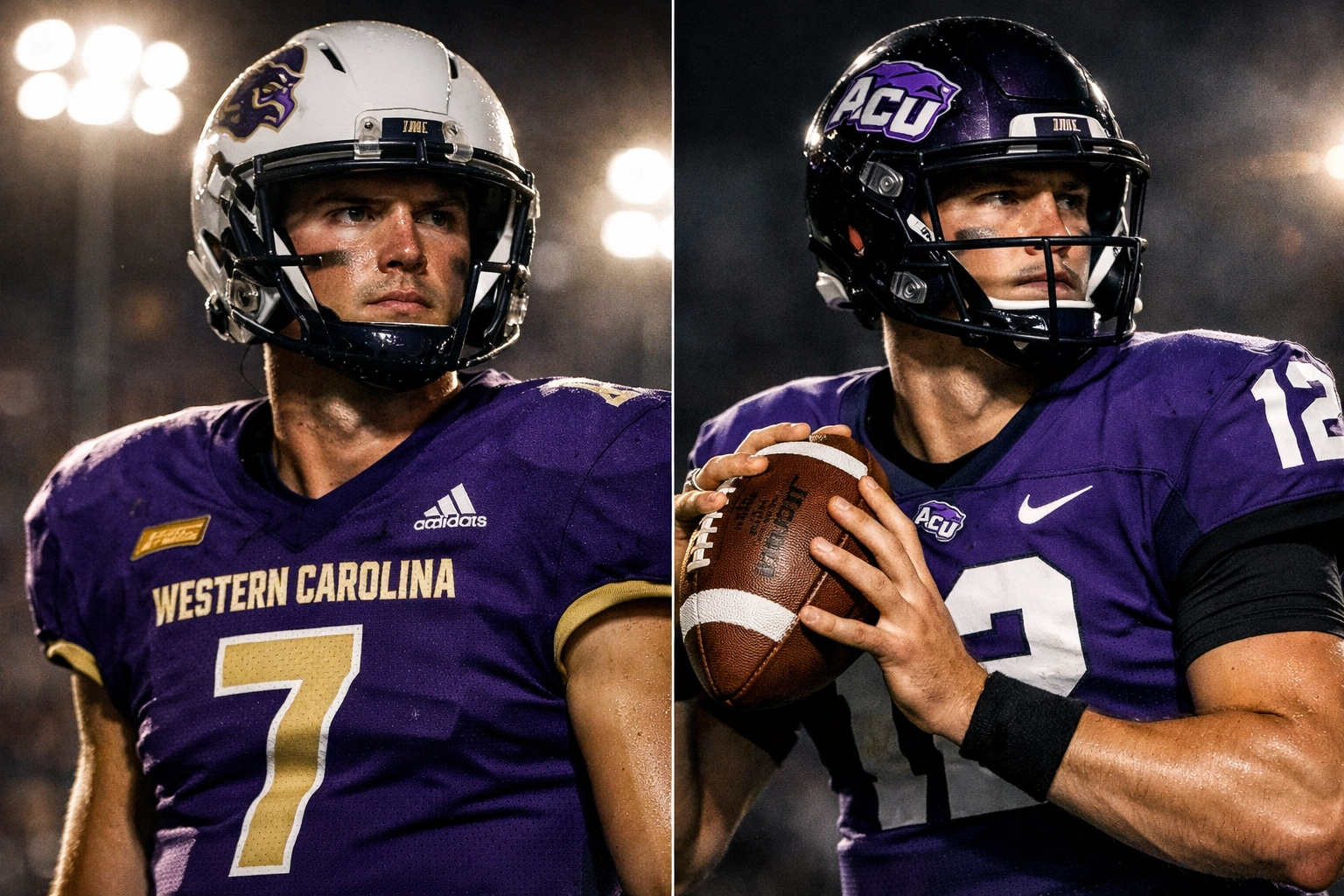
Taron Dickens: The Record-Setting Enigma
Taron Dickens entered the 2025 season under unusual circumstances. The 5-foot-11, 180-pound redshirt junior was suspended for Western Carolina's first three games, forcing him to watch from the sidelines as his team struggled to find offensive rhythm. What followed his return was nothing short of spectacular.
Over nine games, Dickens completed 271 of 365 passes (74.2% completion rate) for 3,508 yards with an absurd 38 touchdowns against just 2 interceptions. His numbers weren't just good: they were historically dominant. On October 4, he set an NCAA record with 46 consecutive completions in a victory against Wofford, a mark that obliterated the previous standard and earned him Southern Conference Offensive Player of the Year honors.
The Film Don't Lie
Dickens' tape showcases elite anticipation, touch, and decision-making. His ability to process coverage post-snap and deliver accurate throws into tight windows separated him from typical FCS signal-callers. He added 321 rushing yards, demonstrating adequate mobility to extend plays when protection broke down.
Early in the portal cycle, Syracuse, James Madison, Toledo, and North Texas all extended offers. The problem? By the time Dickens entered the portal in mid-January, many Power 4 programs had already secured their quarterback solutions. Syracuse landed a higher-profile target. James Madison pivoted to another option. The market moved faster than his timeline allowed.
With two years of eligibility remaining, Dickens represents a rare commodity: a proven, efficient passer who could step in and compete immediately at the Group of 5 or high-level FCS programs. Yet as February arrives, he watches and waits.

Stone Earle: The Journeyman's Last Stand
Stone Earle's story is more complex. The redshirt senior from Abilene Christian is seeking approval for a seventh season of college football, a waiver situation that complicates his recruitment and makes schools hesitant to commit roster resources without clarity on his eligibility status.
In his first full-time starting role in 2025, Earle delivered across 14 games: 295 of 440 completions for 3,285 yards, 22 touchdowns, and 11 interceptions. More impressively, he added 137 carries for 433 rushing yards and 12 rushing touchdowns, showcasing legitimate dual-threat capabilities.
The Transfer Trail
Earle's journey through college football reads like a roadmap of the modern portal era. He's played at North Texas, Marshall, and Abilene Christian, transferring multiple times throughout his career. This history creates both opportunity and concern for potential suitors. On one hand, he brings invaluable experience and proven production. On the other, programs must navigate the NCAA's increasingly complex eligibility rules to determine if he can suit up in 2026.
For teams facing spring camp injuries or unexpected roster departures, Earle represents a "break-glass-in-case-of-emergency" option: a veteran signal-caller who can step in and operate an offense immediately, provided his waiver is granted.
Roster Impact: The Programs Left Behind
The departures of Dickens and Earle have triggered significant roster reconstruction efforts at their former schools, illustrating the ripple effects of portal movement across all levels of college football.
Western Carolina: Total Reset
The Catamounts face a severe challenge. Losing Dickens wipes out virtually all returning passing production: analytics show 0% continuity at the position. Head coach Kerwin Bell and his staff were forced into emergency mode, ultimately landing Lex Thomas, a transfer from NC State who brings Power 4 pedigree but limited on-field experience.
Thomas, a former 3-star prospect, spent two years in Raleigh without seeing significant action. The coaching staff is betting on potential over proven production, hoping that Thomas' high school talent and exposure to an elite program will translate to immediate success in the Southern Conference.
The transition will be jarring. Western Carolina must shift from a record-setting aerial attack built around Dickens' elite efficiency to a more conservative, ground-based approach while Thomas acclimates. Spring camp becomes critical for installing systems that mask his inexperience.
Abilene Christian: Aggressive Reload
ACU head coach Keith Patterson took a different approach. Rather than panic, he orchestrated a massive roster overhaul: approximately 40 new signees: to combat attrition and maintain the program's momentum after a 2025 playoff appearance.
The headliner is Emmett Brown, a transfer quarterback from Coastal Carolina with previous stops at San Jose State. Brown brings FBS experience and a dual-threat skill set that mirrors Earle's capabilities. Patterson is banking on a "reload, not rebuild" philosophy, flooding the roster with competition and talent to maintain ACU's upward trajectory in the United Athletic Conference.
The volume approach mitigates risk. If Brown struggles, ACU has built sufficient depth to pivot quickly. For programs at all levels, this strategy offers a blueprint for navigating sudden roster losses in the portal era.
Intelligence Matrix: Market Depth Analysis
Understanding positional scarcity in the portal market provides critical context for why two 3,000-yard passers remain available in February.
Scarcity Criticality
Offensive Tackle (High VOL): Elite NFL-caliber blindside protectors like Jordan Seaton remain the most sought-after assets. The "Trench Drain" continues as blue-chip offensive linemen command immediate bidding wars, often overshadowing other positions.
Quarterback (Medium VOL): Despite Dickens and Earle's availability, the 2026 portal is described as the deepest quarterback class in history. High-profile starters like Dylan Raiola and Josh Hoover moved quickly, creating a perception that quarterback needs are largely satisfied across major conferences.
Defensive Line (High VOL): Proven pass-rush productivity remains scarce. Programs like LSU and Michigan aggressively targeted the few available impact players, driving up valuations.
Migration Velocity
Oklahoma State (64 departures – Bleeding): The Cowboys lead the nation in portal losses, a staggering number that reflects coaching turnover and NIL challenges.
LSU (40 additions – Gaining): The Tigers rank No. 1 nationally in portal class rankings, adding elite talent across all position groups.
UCLA (41 additions – Gaining): The Bruins are aggressively rebuilding under new leadership, targeting high-volume additions to compete immediately in the Big Ten.
Penn State's Portal Revolution
While Dickens and Earle search for homes, Penn State is making headlines with one of the most aggressive portal approaches in college football history. New head coach Matt Campbell has secured over 36 scholarship transfers, with the majority following him from Iowa State.
The influx includes top prospects like edge rusher Elijah Reeder, effectively rebuilding the Nittany Lions' roster following a late-cycle coaching transition. Campbell's approach represents a new model: rather than gradual roster integration, he's importing an entire system and culture from his previous program.
For youth football programs like Boardwalk Beasts, this offers a valuable lesson: culture and system continuity matter as much as individual talent. Campbell isn't just adding players: he's transplanting the infrastructure that made Iowa State successful. Learn more about our program philosophy and how we build winning cultures from the ground up.
The Waiting Game
As February progresses, both Dickens and Earle face an uncomfortable reality: the best opportunities may have already been claimed. Spring camp injuries, unexpected portal entries during the April 15-30 window, or sudden coaching changes could create new openings. But for now, they wait.
Their situations underscore a harsh truth of the portal era: timing matters as much as talent. A quarterback who enters the portal in December has exponentially more options than one who waits until mid-January, regardless of production. Market dynamics, not just individual merit, determine outcomes.
For programs at every level, these cases offer critical lessons in roster management, talent evaluation, and the importance of developing quarterback depth internally rather than relying solely on external acquisitions.
FINAL ANALYSIS: The continued availability of Taron Dickens and Stone Earle represents both an anomaly and an opportunity in the 2026 transfer market. For programs with remaining scholarship availability or facing spring roster uncertainty, these signal-callers offer proven production and immediate experience. The question is whether someone will pull the trigger before the window closes entirely.
At Boardwalk Beasts Football Club, we understand that elite quarterback play starts with proper development, not just portal acquisitions. Our quarterback training programs focus on mechanics, decision-making, and leadership: the same skills that made Dickens and Earle successful at the college level. Whether your athlete dreams of playing FCS, FBS, or beyond, we provide the foundation for success.
Ready to develop the next elite signal-caller? Visit myfootballcamps.com to explore our recruiting programs and youth football camps. The portal may be unpredictable, but proper development never goes out of style.
About Author
