
Intelligence Matrix: Real-Time Market Depth Analytics
Powered by PortalIntel.AI
The 2026 transfer portal cycle has closed, and the data reveals a market more volatile and expensive than ever before. Understanding position scarcity, NIL inflation, and program migration patterns is no longer optional: it's essential for anyone serious about competitive football intelligence. Whether you're a coach building a roster, a parent navigating the recruiting landscape, or an athlete trying to understand your market value, our programs at Boardwalk Beasts prepare you for this new reality.
This Intelligence Matrix breaks down real-time market depth analytics across critical positions and programs, revealing where scarcity drives value and which institutions are winning or losing the talent war.
Scarcity Criticality: Position-by-Position Market Analysis
Quarterback: Record-Breaking Valuations
Volatility Level: HIGH
The quarterback market reached unprecedented heights in 2026, with NIL packages climbing as high as $5 million for proven multi-year starters. The market fundamentals are simple: supply is critically low, and demand is astronomically high.
Sam Leavitt's move from Arizona State to LSU exemplifies this scarcity premium. After a breakout season in the Big 12, Leavitt commanded immediate bidding wars from multiple SEC programs before Lane Kiffin secured him as the centerpiece of the nation's No. 1 portal class. Similarly, Drew Mestemaker triggered a frenzy among Power 4 programs desperate for experienced signal-callers.
The quarterback drought stems from three factors: earlier NFL declarations, programs holding onto starters longer, and the high bust rate of developmental prospects. The result? Mid-tier G5 quarterbacks with 15-20 career starts are now receiving Power 4 offers previously reserved for elite prospects.
Market Implication: Programs without a proven QB1 entering the 2026 season face an uphill battle. Duke's loss of Darian Mensah to Miami created an immediate crisis, forcing the Blue Devils to scramble for lower-tier solutions late in the cycle.

Offensive Tackle: The Trench Drain Continues
Volatility Level: HIGH
The "Trench Drain" phenomenon: the exodus of elite offensive linemen to the NFL or portal: has created acute scarcity at the tackle position. Blue-chip protectors like Jordan Seaton (Colorado to LSU) and Lance Heard are rare commodities, commanding premium valuations and forcing programs to overvalue mid-tier G5 starters.
The offensive tackle market is uniquely challenging because elite tackles possess a specific combination of attributes: length, lateral agility, and functional strength. These traits don't develop overnight, making portal acquisitions critical for programs that lose starters to the NFL.
LSU's acquisition of Seaton represents a master class in market timing. Seaton, a former 5-star recruit with All-Big 12 credentials, fills the exact void left by NFL departures. Programs that miss on elite portal tackles often resort to developmental freshmen or position conversions: both risky propositions for immediate competitiveness.
Market Implication: The offensive tackle market will remain seller-friendly for the foreseeable future. Programs must prioritize retention and early identification of portal targets.
Edge Rusher: The Game-Wrecker Premium
Volatility Level: HIGH
Elite pass-rush productivity remains the most difficult metric to find in the transfer portal. The market is dominated by a handful of "game-wreckers": disruptive edge rushers who can single-handedly alter opposing offensive gameplans.
Princewill Umanmielen's move from Ole Miss to LSU (following Lane Kiffin) and Chaz Coleman's market movement highlight this scarcity. Umanmielen's proven SEC production (9+ sacks) makes him an immediate defensive upgrade, while Miami's acquisition of Damon Wilson II from Missouri (9 sacks in 2025) directly replaced departing NFL stars Rueben Bain Jr. and Akheem Mesidor.
The edge rusher premium exists because production is immediately quantifiable. Sacks, pressures, and tackles for loss translate across systems, making elite rushers plug-and-play assets. Programs searching for pass-rush help often settle for developmental projects or hope scheme adjustments can compensate: rarely effective strategies.
Market Implication: Programs losing elite edge rushers to the NFL or portal face defensive regression unless they secure proven replacements. The gap between elite and replacement-level talent is massive.

Wide Receiver: Volume vs. Elite Speed
Volatility Level: MEDIUM
The wide receiver market presents a paradox: high entry volume but persistent NIL inflation for top-tier speed assets. Elite portal receivers like Cam Coleman and Nick Marsh created market movement, but the sheer number of available wideouts provides more options than other scarcity positions.
Miami's dual acquisition of Duke's Cooper Barkate and West Virginia's Cam Vaughn demonstrates both sides of the WR market. Barkate brings established chemistry with quarterback Darian Mensah (72 receptions, 1,106 yards at Duke), while Vaughn adds pure speed to stretch defenses vertically. Both commanded significant NIL packages, but the availability of depth options kept valuations below quarterback levels.
The wide receiver position benefits from offensive system diversity. Slot receivers, boundary threats, and possession targets all have market value, creating more pathways for athletes to find landing spots. However, true "take-the-top-off" speed remains scarce and expensive.
Market Implication: Programs can fill receiver depth through the portal, but elite speed assets still require premium investment. Chemistry with quarterbacks adds value beyond pure athleticism.
Tight End: The Deepest Pool
Volatility Level: LOW
The tight end position represents the transfer portal's deepest talent pool in years, driven by offensive system shifts away from traditional two-tight-end sets. Developmental "high-ceiling" assets are plentiful, though immediate blocking utility remains limited.
This abundance stems from roster compression. As offenses prioritize spread concepts and empty formations, tight ends see reduced snap counts, prompting transfers seeking more opportunities. Programs seeking pass-catching tight ends have multiple options, though finding complete players who excel in both receiving and blocking remains challenging.
Market Implication: Tight end represents the portal's best value position. Programs can secure developmental talent without breaking NIL budgets, though patience is required for blocking technique refinement.
Migration Velocity: Program Trends
Programs Bleeding Talent
The migration velocity data reveals which programs are hemorrhaging talent through portal departures:
Oklahoma State (64 Departures)
The Cowboys lead the nation in portal losses, signaling potential program instability or roster dissatisfaction. Sixty-four departures represent nearly half of a typical roster: a complete teardown requiring aggressive rebuilding through high school recruiting and return portal acquisitions.
Iowa State (47 Departures)
The Cyclones' exodus suggests either coaching changes, NIL challenges, or poor fit between players and system. Losing 47 players mid-cycle makes immediate competitiveness nearly impossible.
West Virginia (46 Departures)
The Mountaineers join the Big 12 bleeding trend, losing key contributors like receiver Cam Vaughn to Miami. The program faces roster reconstruction heading into 2026.
These programs share common characteristics: mid-tier conference positioning, limited NIL resources compared to SEC/Big Ten programs, and difficulty competing for elite portal replacements. The "rich get richer" portal dynamics create widening competitive gaps.
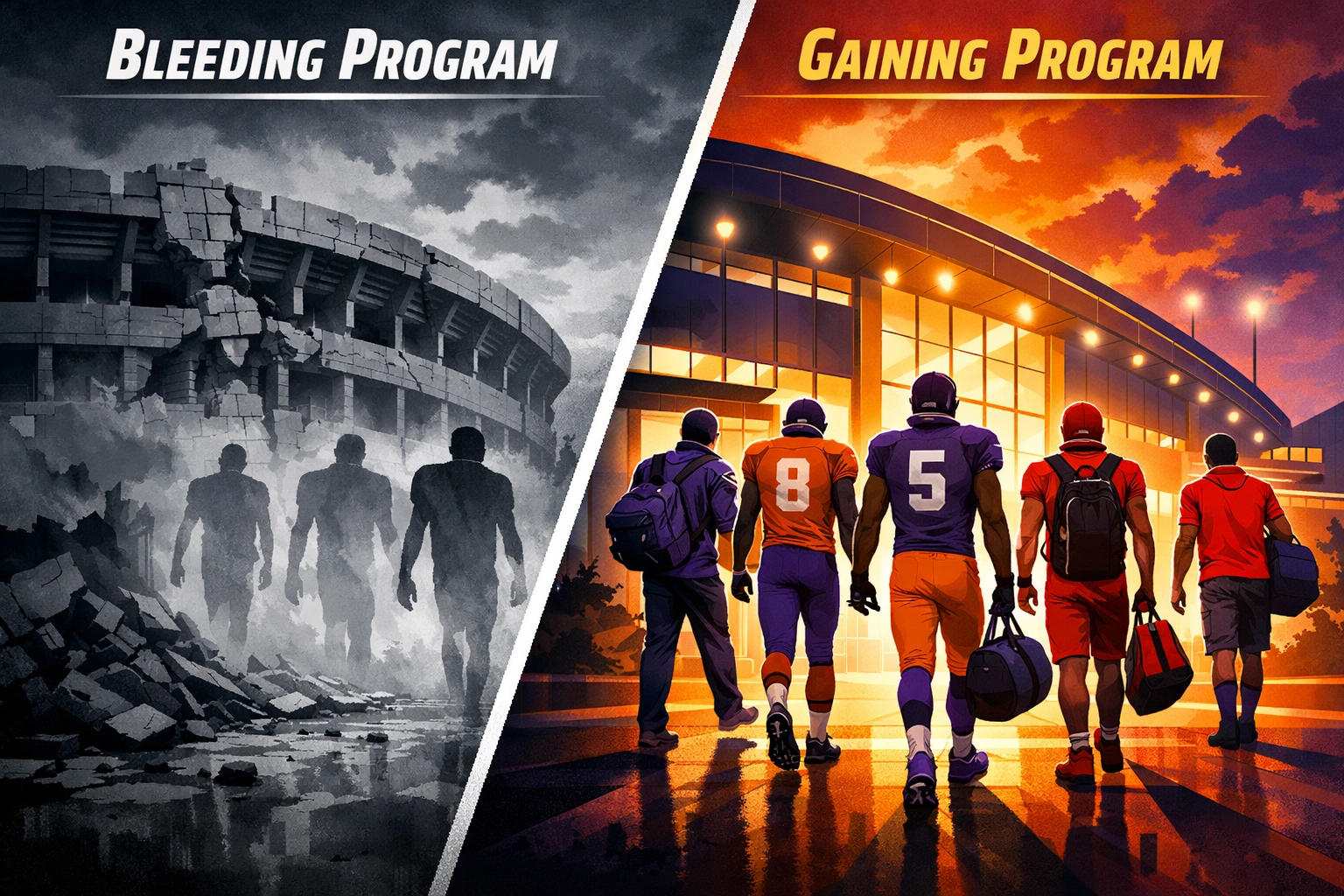
Programs Gaining Ground
Conversely, aggressive portal acquirers demonstrate strategic investment and winning culture:
LSU (40 Additions)
Lane Kiffin's "Portal King" status cemented with the nation's No. 1 portal class. LSU executed surgical roster upgrades across quarterback (Sam Leavitt), offensive line (Jordan Seaton), and edge rusher (Princewill Umanmielen). The Tigers transformed from transition uncertainty to playoff contention through strategic acquisitions.
Auburn (39 Additions)
The Tigers invested heavily in portal talent, signaling a commitment to immediate competitiveness. Auburn's aggressive approach mirrors LSU's philosophy: use the portal to close talent gaps rather than waiting on high school development.
Kentucky (29 Additions)
Mark Stoops continues building through the portal, adding experienced depth across positions. Kentucky's measured approach balances high school recruiting with strategic portal additions, avoiding roster churn while upgrading talent.
These programs share institutional advantages: competitive NIL collectives, SEC prestige, and coaching staffs experienced in portal evaluation. They recognize the portal as a roster-building tool, not a desperate measure.
What This Means Moving Forward
The 2026 transfer portal cycle solidifies several market realities:
-
Position scarcity drives extreme valuations. Quarterbacks and offensive tackles will continue commanding premium NIL packages due to supply limitations.
-
Portal success requires institutional commitment. Programs with robust NIL infrastructure and evaluation resources dominate portal acquisitions. Those relying solely on high school recruiting fall further behind.
-
Migration velocity predicts competitive trajectories. Programs bleeding 40+ players face multi-year rebuilds. Programs strategically adding 30-40 talents position themselves for immediate success.
-
Chemistry matters more than raw talent accumulation. Miami's acquisition of the Mensah-Barkate duo from Duke demonstrates the value of established on-field relationships. Pure talent collection without considering scheme fit and locker room culture produces disappointing results.
For youth athletes and their families, understanding these market dynamics is crucial. Our recruiting programs at Boardwalk Beasts prepare athletes for this hyper-competitive landscape, teaching the skills and mindset required to become portal-worthy prospects.
The portal has fundamentally altered college football's competitive structure. Programs that master portal evaluation, NIL deployment, and roster management will dominate the next decade. Those that resist adaptation will watch talent: and wins: migrate elsewhere.
Ready to prepare your athlete for the competitive future of football? Whether you're developing fundamental skills for youth players or building recruiting profiles for high school prospects, Boardwalk Beasts Football Club provides the training, exposure, and strategic guidance to compete at the highest levels. Visit boardwalkbeastsfb.com to explore our programs, or check out Coach Schuman's recruiting resources to understand how today's market dynamics impact tomorrow's opportunities.
About Author
