How the Forward Pass Revolutionized Football
Picture this: You're watching a football game where every single play is a run up the middle. No passing. No creativity. Just 22 players smashing into each other over and over again. Sounds pretty boring, right? Well, that's exactly what football looked like before 1906. The forward pass, something we take for granted today, didn't even exist. And when it finally became legal, most coaches thought it was for wimps.
Here's the wild story of how one rule change transformed football from a brutal, predictable slugfest into the dynamic sport that gets your heart racing every Friday night.
When Football Was Actually Dangerous (More Than Today)
Before we dive into the forward pass revolution, let's set the scene. Early football was basically organized violence with some rules sprinkled on top. We're talking about the early 1900s when players wore leather helmets that offered about as much protection as a baseball cap.
The game revolved around something called "mass plays", imagine 11 players linking arms and charging forward like a human battering ram. The defense would do the same thing coming the other way. The result? Broken bones, concussions, and unfortunately, sometimes worse.
In 1905 alone, 18 college players died from football injuries. Eighteen! That's not a typo. The game was so violent that newspapers were calling for it to be banned completely. Players couldn't throw the ball forward, they could only run it or kick it. This made the game incredibly predictable and, as a result, incredibly dangerous since defenders knew exactly where the action was going.
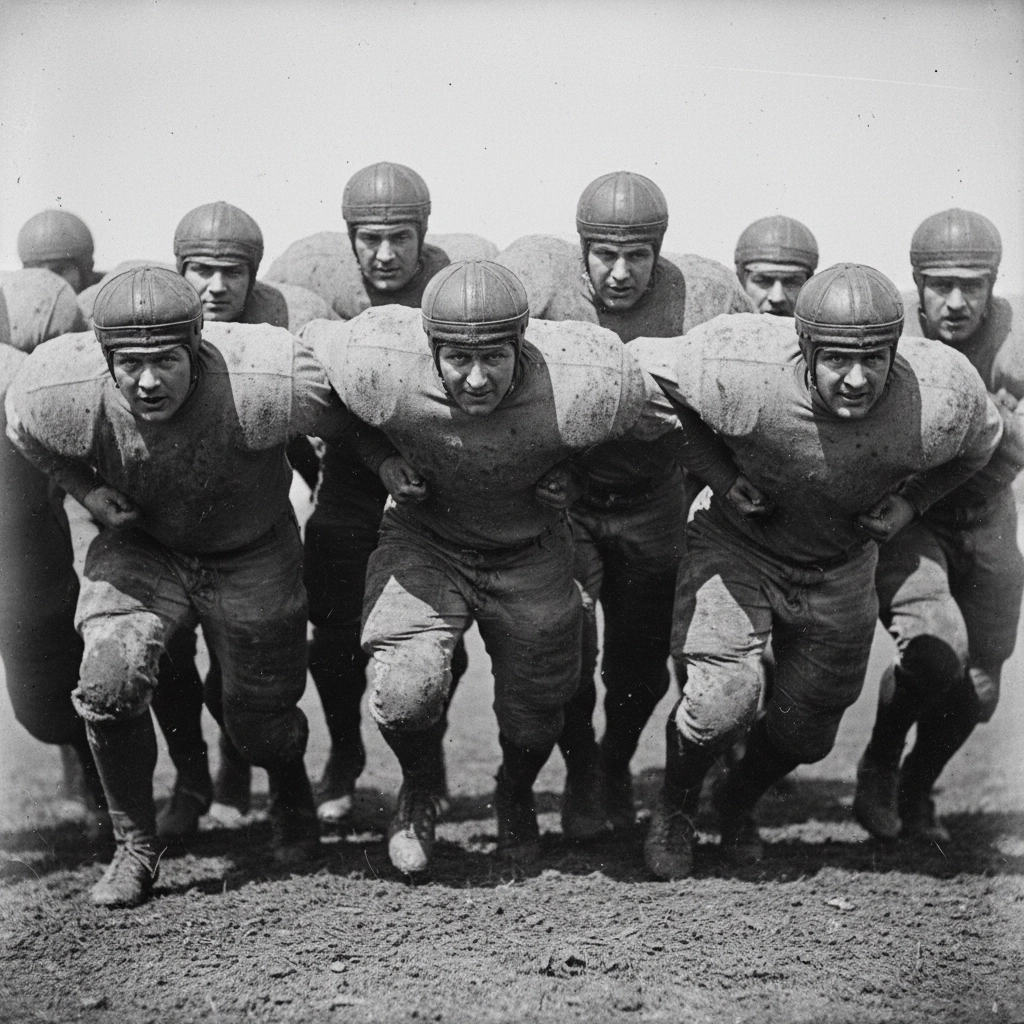
Think about it from a strategic standpoint. If you're a coach and you know the other team can only run the ball, you're going to pack as many players as possible into the middle of the field. When both teams do this, you get massive collisions on every single play. It was like watching two freight trains crash into each other 60 times a game.
Enter Teddy Roosevelt: The President Who Saved Football
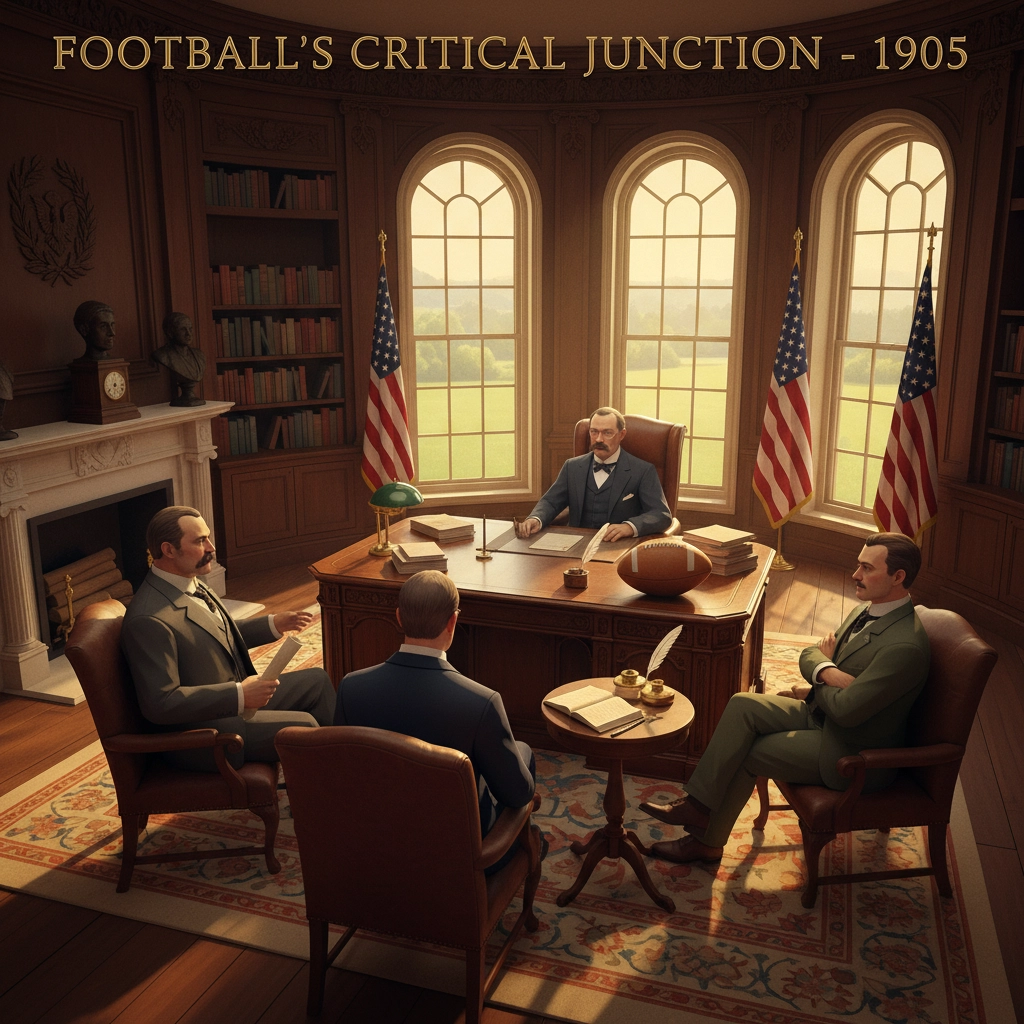
Here's where the story gets interesting. President Theodore Roosevelt, yeah, the guy who charged up San Juan Hill, was a huge football fan. His own son played for Harvard. But even Teddy could see that the sport was heading toward a complete ban if something didn't change.
In 1905, Roosevelt called representatives from Harvard, Yale, and Princeton to the White House. Basically, he told them: "Fix this sport or lose it forever." This wasn't just a suggestion from some politician, this was the President of the United States giving college football an ultimatum.
The pressure worked. College football's rules committee knew they had to act fast. They couldn't just tinker around the edges; they needed revolutionary changes that would open up the game and reduce the constant head-on collisions that were killing players.
The Birth of the Forward Pass (With Training Wheels)
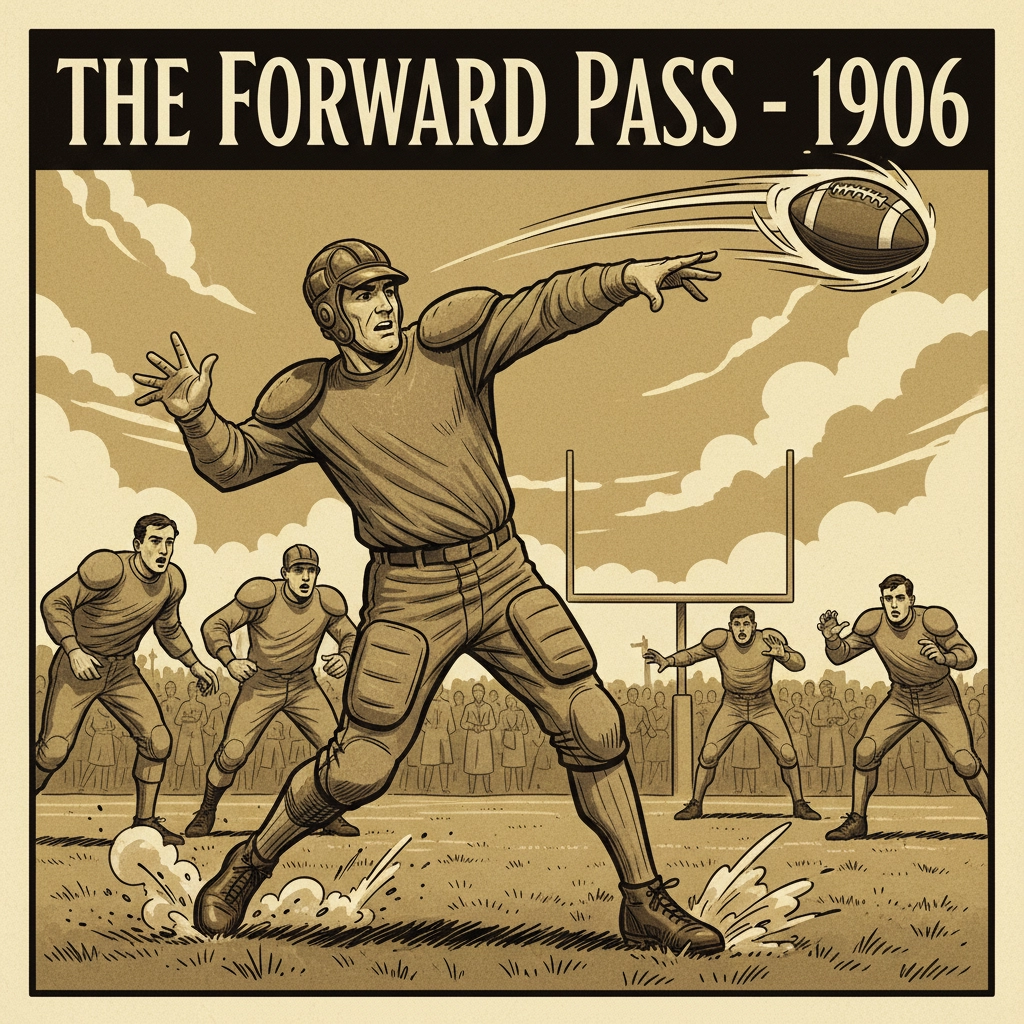
On January 12, 1906, the football rules committee made history. They legalized the forward pass. But here's the catch, they were so nervous about this radical change that they loaded it up with restrictions that would make your head spin.
First, if you threw an incomplete pass, your team got hit with a 15-yard penalty. Imagine that in today's game! Second, if your pass hit the ground without anyone touching it, the other team got the ball. Third, you could only throw the ball 10 yards downfield, and you couldn't throw it beyond the 25-yard line.
Most coaches took one look at these rules and said, "No thanks." They saw the forward pass as a gimmick, a "sissified" way to play football that wasn't really football at all.
The First Legal Forward Pass in History
September 5, 1906. St. Louis University versus Carroll College. This is when football history was made, though hardly anyone noticed at the time.
Quarterback Bradbury Robinson dropped back and threw a 20-yard pass to Jack Schneider. It was successful, and it was legal. The first forward pass in football history was officially in the books.
But here's the crazy part, almost nobody cared! The newspapers barely covered it. Coaches didn't suddenly start drawing up passing plays. The revolution had technically begun, but it was moving at the speed of molasses.
A month later, when Wesleyan's Sam Moore completed a pass against Yale, it got more attention simply because it was against Yale. But even then, most teams kept running the ball just like they always had.
The Innovators Who Saw the Future
While most coaches were stuck in the past, a few visionaries saw the forward pass's potential. Pop Warner at Carlisle was one of them. He recognized that the pass wasn't just a trick play, it was a weapon that could completely change offensive strategy.
Warner developed what he called "the Carlisle formation," an early version of the single wing that made the forward pass a central part of his offense. His players at Carlisle became so good at passing that, according to one historian, "Once they started practicing it, Warner pretty much couldn't stop them" from wanting to throw the ball.
But even Warner's success wasn't enough to convince the football establishment. Most coaches were still treating the forward pass like a desperate Hail Mary rather than a legitimate offensive tool.
The Game That Changed Everything: Notre Dame vs. Army, 1913
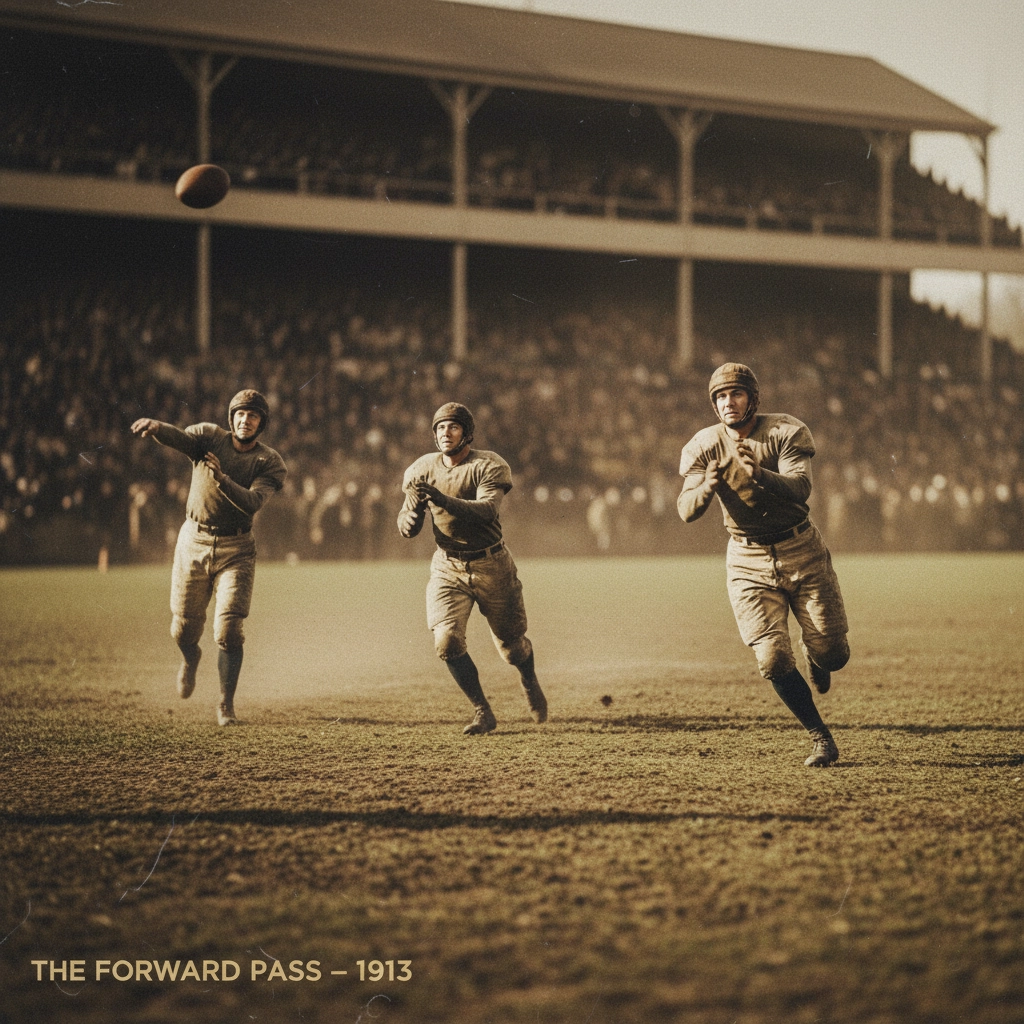
November 1, 1913. This is the date every football fan should know by heart. Notre Dame, a small Catholic school from Indiana, traveled to West Point to play the mighty Army team. Nobody expected it to be much of a game.
What happened next shocked the football world.
Notre Dame quarterback Gus Dorais completed 14 of 17 passes for 243 yards. One of his favorite targets was a scrappy end named Knute Rockne (yes, that Knute Rockne). The Fighting Irish didn't just win: they demolished Army 35-13, and they did it through the air.
This wasn't just a football game; it was a demonstration of what the sport could become. The forward pass had finally found its moment. After this game, as one sports historian put it, "the forward pass occupied a prominent position in offensive strategy."
How the Pass Transformed Football Forever
The forward pass didn't just add a new play to football's playbook: it completely reimagined what the sport could be. Instead of mass formations crashing into each other, teams could now spread out across the field. Speed and precision became as important as size and strength.
The change appealed to everyone. Players loved it because it rewarded athleticism and creativity. Fans loved it because games became more exciting and unpredictable. Even college administrators loved it because it made football safer and more acceptable to the public.
By 1913, the rules committee had also removed most of the punitive restrictions on passing. Incomplete passes were no longer penalized, and teams could throw over the center of the line. The forward pass was finally free to reach its potential.
The Ripple Effects of Revolution
The legalization of the forward pass set off a chain reaction that's still shaping football today. Coaches had to develop entirely new strategies. Players had to master completely different skills. The game went from being about pure power to being about chess-match strategy.
Think about some of the concepts we take for granted in modern football: route running, pass coverage, pocket protection, reading defenses. None of these existed before the forward pass. The entire vocabulary of football had to be reinvented.
Teams also had to get more athletic. When every play was a running play, you could succeed with big, slow players who could push people around. But when the pass opened up the field, teams needed players who could run, catch, and think on their feet.
Why This Matters for Today's Young Athletes
So why should today's youth football players care about something that happened over a century ago? Because it shows how innovation and adaptation can completely transform a sport: and individual players.
The forward pass revolution reminds us that football is always evolving. The players who succeeded after 1913 weren't necessarily the biggest or strongest: they were the ones who best adapted to the new style of play. They learned new skills, embraced new strategies, and thought about the game differently.
At Boardwalk Beasts Football Club, we teach our players to have that same innovative mindset. The game keeps changing, and the athletes who thrive are the ones who stay ahead of the curve, whether that's mastering new techniques, understanding evolving strategies, or developing the mental toughness to adapt when everything around them shifts.
The forward pass revolution also shows us that sometimes the biggest breakthroughs come from the most unlikely places. Notre Dame wasn't supposed to beat Army that day in 1913. They were the underdogs using a "gimmicky" new strategy against a traditional powerhouse. But they had practiced, they had believed in their system, and they had executed when it mattered most.
The Legacy Lives On
Today, when you watch a quarterback drop back and launch a perfect spiral downfield, remember that play was once illegal. When you see a receiver run a precise route and make a spectacular catch, remember that those skills didn't exist in football's early days.
The forward pass transformed football from a game of pure brutality into a sport that rewards intelligence, creativity, and athletic ability. It saved the sport from extinction and created the foundation for every touchdown pass, every comeback victory, and every championship celebration that followed.
That's the power of innovation in sports: and in life. Sometimes one rule change, one new idea, or one person willing to think differently can revolutionize everything. The forward pass didn't just change football; it created the game we love today.
About Author