
The Larry Johnson Tax: Why Miami Paid a Premium for Jarquez Carter
Looking to develop elite football skills like the top college prospects? Check out our programs at myfootballcamps.com and learn more about the Boardwalk Beasts at boardwalkbeastsfb.com.
The transfer portal has officially become Wall Street for college football. Every January, we watch programs place bets, absorb losses, and occasionally, just occasionally, find a market inefficiency that makes you tip your cap.
When Jarquez Carter committed to the Miami Hurricanes on January 10, 2026, most casual fans saw a simple defensive tackle transfer. But if you understand the economics of modern college football, you saw something far more interesting: Miami paying what we're calling "The Larry Johnson Tax."
And honestly? It might be the smartest money they've spent all offseason.
What Exactly Is the "Larry Johnson Tax"?
Let's set the scene. Larry Johnson isn't just Ohio State's defensive line coach, he's the closest thing college football has to a guaranteed return on investment. The man has turned more defensive linemen into NFL Draft picks than some entire conferences. Chase Young. Nick Bosa. Joey Bosa. The Buckeyes' D-line factory has been churning out first-round picks like it's an assembly line.
So when a player spends even one year in Larry Johnson's system, they come out the other side with something money can't easily replicate: elite technique development.
That's the tax.
Miami didn't just acquire Jarquez Carter. They acquired a player who already absorbed Ohio State's world-class coaching, strength programming, and schematic education, without having to do any of the foundational work themselves.
The Hurricanes essentially got a player with a year of Ivy League education… at community college prices.

The Financial Breakdown: From Freshman Tier to Portal Premium
Here's where the numbers get spicy.
During his true freshman season at Ohio State, Carter was operating on what the NIL market calls a "development tier" valuation:
| Metric | Ohio State (2025) | Miami (2026 Projected) |
|---|---|---|
| Annual NIL Value | $50,000 – $100,000 | $322,000 – $450,000 |
| Collective Support | The Foundation (OSU) | Canes Connection |
| Monthly Stipend Range | ~$4k–$8k | ~$25k–$30k |
That's a 3x to 5x increase in valuation simply by entering the transfer portal and landing at a program willing to pay market rate.
But here's the kicker: defensive tackles are the second-highest paid position group in the portal, trailing only quarterbacks. Interior linemen who can actually penetrate and disrupt are rare. Programs are desperate for them. And Carter fits the prototype.
Miami's aggressive NIL collective, Canes Connection, is known for throwing around significant money for immediate-impact transfers. A rotation-ready DT with Carter's pedigree and remaining eligibility? That's exactly the type of asset they're built to acquire.
The Hurricanes aren't overpaying. They're paying the market rate for a player whose stock just happened to spike at the exact right moment.
The Scouting Report: An Aaron Donald Prototype
Now let's talk about what Miami is actually getting on the field.
Carter stands at 6'2", 284 pounds. By traditional NFL scouting standards, he's "undersized" for a defensive tackle. The league typically wants its interior linemen at 6'4" or taller, with enough mass to absorb double teams.
But Carter isn't built to absorb anything. He's built to destroy.
Scouting Summary:
- Position: Defensive Tackle (3-Technique)
- Best Trait: Snap anticipation and first-step burst
- Playing Style: Gap-shooter, not a run-stuffer
- Comparison: Aaron Donald (yes, really)
When scouts use the Aaron Donald comp, they're not saying Carter is going to be a future Hall of Famer. They're describing a playing style, an undersized interior lineman who wins with explosion, leverage, and violent hand usage rather than sheer mass.
Carter's tape shows a player who times the snap better than most veterans. He's in the backfield before the offensive line finishes their first step. His hands are active and punishing. He's a disruptor, not a space-eater.
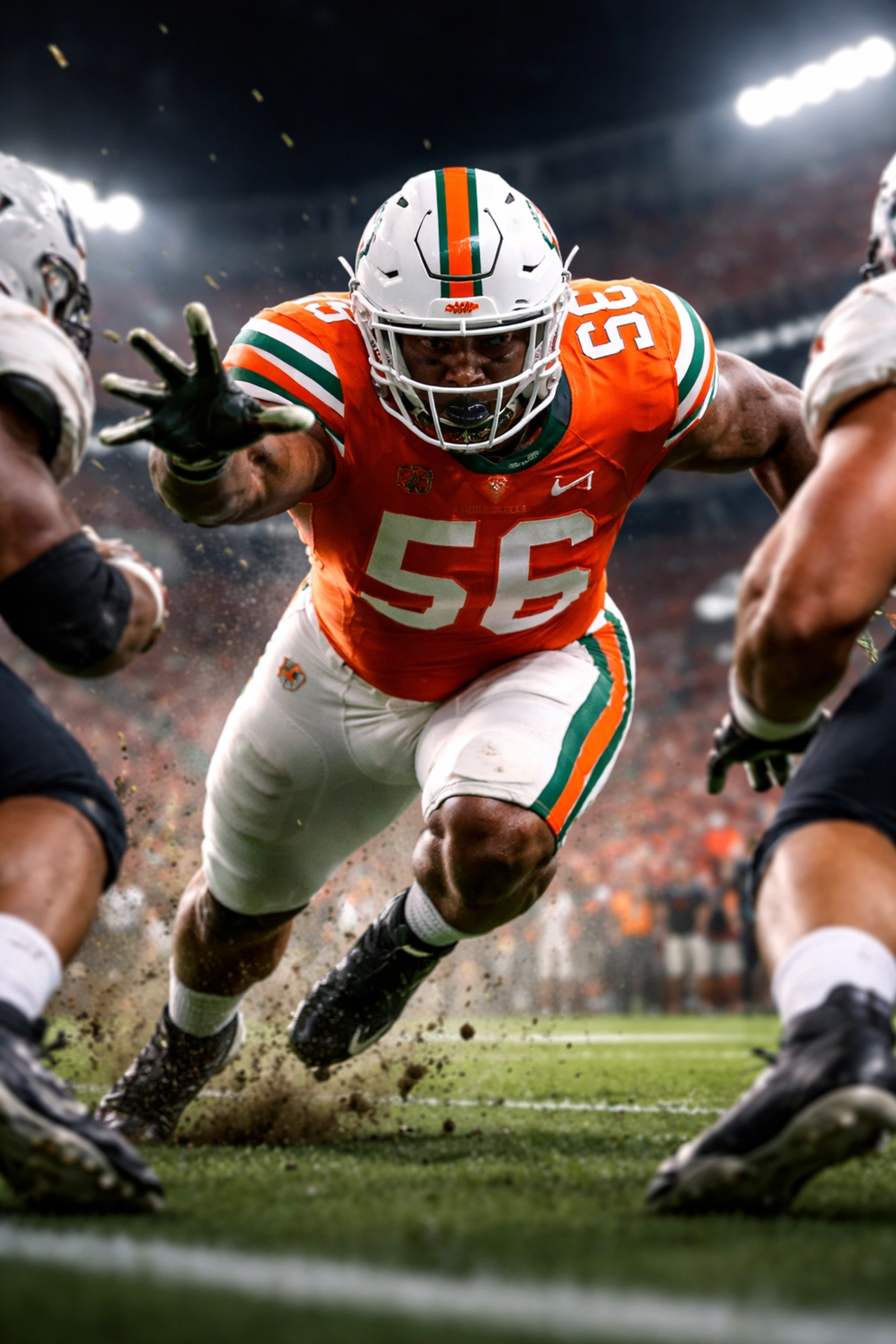
Development Need: The one area Carter must improve is adding functional weight without losing his speed. ACC and SEC offensive lines will throw double teams at him constantly. He needs to learn to hold his ground on early downs while still unleashing chaos on passing situations.
The good news? He's got four years of eligibility left to figure it out.
The ROI Analysis: Ohio State's Loss Is Miami's Gain
This is where the "Moneyball" lens gets fascinating.
Ohio State's Investment (Sunk Cost):
- One year of scholarship resources
- Estimated $50k–$75k in NIL payouts
- Access to Larry Johnson's coaching and OSU's elite strength program
- Four games played (redshirt preserved)
- Production: 1-2 tackles, limited snaps
Verdict: Negative ROI.
Ohio State paid the acquisition cost, the recruiting resources, the initial NIL signing bonus, the development investment, hoping for a multi-year payoff. By transferring after one season, Carter left the Buckeyes holding the bag. They absorbed all the development cost without receiving the on-field production yield.
This is the brutal math of the transfer portal era. Sometimes you develop a player, and someone else reaps the benefits.
Miami's Acquisition:
- Projected Annual Cost: $325k–$400k
- Projected Role: Rotation DT (20-30 snaps per game)
- Eligibility Remaining: 4 years
- Development Status: Pre-trained by Larry Johnson
Verdict: High-upside value play.
Miami is paying a premium, yes. But they're getting a "pre-developed" asset with four years of eligibility remaining. If Carter records 3-5 sacks and plays 300+ snaps in 2026, his production will vastly outperform his financial cost compared to hiring a veteran transfer DT: who often commands $600k or more annually.
The risk is significantly lower than a high school recruit, but the ceiling is just as high.

The Hometown Hero Narrative
There's another layer to this story that shouldn't be overlooked.
Jarquez Carter is a Florida kid. Born and raised in Newberry: a small town just outside Gainesville. He grew up in Gator Country, committed to Ohio State, and now he's coming back home to South Florida.
From a marketing perspective, this is gold.
Carter's NIL value isn't just about his on-field production. It's about his regional appeal. Central Florida (the Gainesville/Newberry corridor) and South Florida (Miami's backyard) represent two of the most talent-rich recruiting areas in the country. Having a homegrown player wearing the orange and green creates authentic storytelling opportunities that brands love.
He's not yet a national marketing face: and that's okay. His value is in being a hometown hero, a Florida product who chose to rep his state at the highest level.
For Miami's collective and local sponsors, that narrative writes itself.
What This Means for Portal Economics
Carter's transfer is a case study in how the modern portal market operates:
-
Development programs absorb early costs. Schools like Ohio State and Alabama invest heavily in freshmen, knowing some percentage will transfer before they contribute.
-
Destination programs pay acquisition premiums. Schools like Miami and Texas are willing to pay 3-5x market rate for players who are "portal-ready."
-
Coaching pedigree has tangible value. A year under Larry Johnson, Nick Saban, or Kirby Smart adds real dollars to a player's valuation.
-
Positional scarcity drives pricing. Defensive tackles and offensive linemen command premiums because they're harder to find in the portal than skill players.
The "Larry Johnson Tax" isn't unique to Carter. It's a market phenomenon. And smart programs are learning to exploit it: both by developing players (and hoping they stay) and by acquiring developed players from rivals.
The Bottom Line
Miami paid a premium for Jarquez Carter. There's no getting around that.
But they paid for a player who:
- Already has elite D-line coaching in his background
- Has four years of eligibility remaining
- Fits the "Aaron Donald prototype" that coordinators dream about
- Is a Florida kid with authentic regional appeal
The Hurricanes aren't gambling. They're making a calculated investment in a high-floor, high-ceiling asset.
Ohio State absorbed the development cost. Miami gets the finished product.
That's the Larry Johnson Tax. And honestly? It's worth every penny.
Want to develop the next generation of elite football players? Explore our programs at myfootballcamps.com, check out coachschuman.com for coaching resources, and learn about the Boardwalk Beasts at boardwalkbeastsfb.com.
About Author
