
Speed Kills: 5 Steps How to Improve Your 40-Yard Dash Time and Dominate the Field (Easy Guide for Young Athletes)
Every college scout knows it. Every coach watches for it. Every athlete dreams about it. That blazing 40-yard dash time that separates the good from the elite, the benchwarmers from the starters, the overlooked from the recruited.
Here's the reality: speed kills on the football field, and your 40-time is the first thing coaches notice. Whether you're trying to make varsity, catch a scout's attention, or dominate your competition, improving your sprint speed isn't just about running faster: it's about unlocking your athletic potential and taking your game to the next level.
At Boardwalk Beasts Football Club, we've helped countless young athletes shave precious seconds off their 40-yard dash times. The difference between a 5.2 and a 4.8 forty isn't just four-tenths of a second: it's the difference between riding the bench and making game-changing plays.
Step 1: Master Your Starting Stance and First Step Explosion
Your 40-yard dash is won or lost in the first 10 yards, and it all starts with your stance. Most young athletes get this completely wrong, costing them valuable time before they even take their first step.
Set up with your dominant foot slightly forward, about 18-24 inches behind the starting line. Your hands should be shoulder-width apart, fingers spread wide for maximum stability. Here's the key detail most athletes miss: your hips must be higher than your shoulders. This creates the optimal angle for explosive acceleration.
Your weight should be distributed 60% on your hands, 40% on your feet. You should feel slightly cramped in this position: if you're comfortable, you're not aggressive enough in your setup. Keep your eyes focused on a spot 2-3 feet ahead of you, not on the finish line.

The first step is everything. Drive your front knee forward and up while simultaneously pushing back with your rear foot. Your first three steps should be short, powerful, and focused on acceleration, not speed. Think "quick feet" rather than "long strides" during this crucial phase.
Practice this starting sequence 15-20 times per training session until it becomes automatic. Time your first 10 yards separately: this is where championships are won.
Step 2: Build Explosive Power Through Strategic Plyometrics
Raw leg strength means nothing without the explosive power to convert it into speed. Plyometric training develops the stretch-shortening cycle in your muscles, creating the spring-like action that separates fast athletes from average ones.
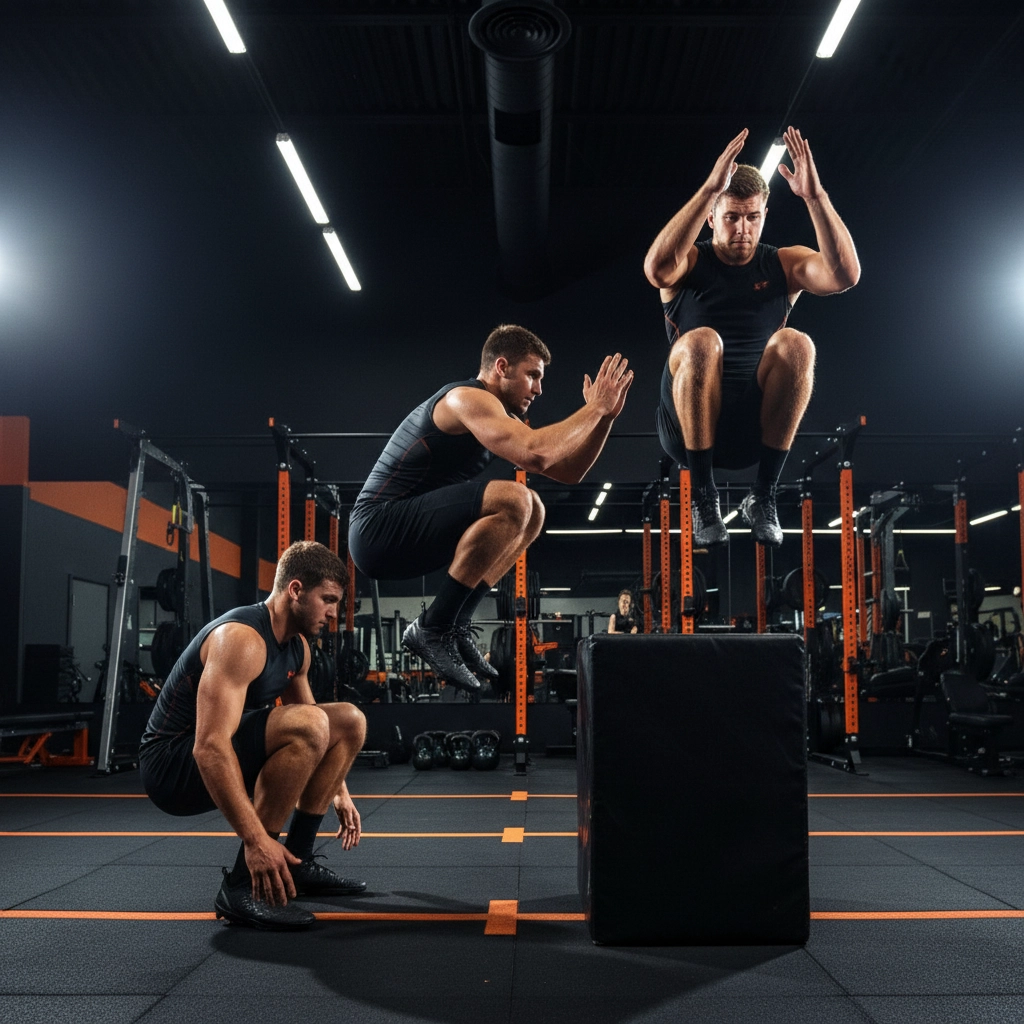
Box jumps are your foundation exercise. Start with a height that challenges you but allows perfect form: typically 18-24 inches for most young athletes. Focus on soft landings and explosive takeoffs. Perform 3 sets of 8-10 jumps twice per week.
Single-leg bounds take this to the next level. From a standing start, bound forward on one leg for maximum distance, then switch legs. This develops unilateral power and teaches your body to generate force from awkward positions: exactly what happens during acceleration.
The staggered broad jump is specifically designed for 40-yard dash improvement. Set up in your starting stance, then perform a broad jump while keeping both feet in contact with the ground as long as possible. This drill teaches you to explode off both legs simultaneously, mimicking the exact movement pattern of your sprint start.
Incorporate depth jumps for advanced athletes. Step off a 12-18 inch box, land softly, then immediately explode into a vertical jump. This develops reactive strength and teaches your nervous system to rapidly switch from lengthening to shortening contractions.
Step 3: Perfect Your Sprint Mechanics and Running Form
Speed isn't just about how fast your legs move: it's about how efficiently your entire body works as a system. Poor mechanics will sabotage even the strongest athlete, while perfect technique can help an average athlete dominate faster competitors.
During acceleration (first 30 yards), maintain an exaggerated forward lean. Your body should form approximately a 45-degree angle with the ground for the first few steps, gradually rising to vertical as you reach top speed. This forward lean prevents you from reaching maximum velocity too early, allowing for sustained acceleration through the crucial middle portion of your sprint.
Arm mechanics are critical and often overlooked. Keep your arms bent at 90 degrees throughout the entire sprint. Focus on driving your elbows back rather than swinging your arms forward: the forward motion happens naturally. Your hands should travel from hip to shoulder height, never crossing the midline of your body.
Knee drive separates good from great. Your thighs should reach parallel to the ground during the drive phase, while your recovery leg should have a tight heel-to-glute relationship. Think about "clawing" at the ground with your feet rather than reaching forward with your stride.
The wall drill perfects these mechanics. Lean against a wall at nipple height, maintain a tight core, and practice alternating knee drives while clawing at the ground with each foot placement. Perform 3 sets of 20 steps per leg during every speed session.
Step 4: Develop Football-Specific Strength Training
Generic gym workouts won't cut it if you want elite sprint speed. Your strength training must target the specific muscle groups and movement patterns that translate directly to 40-yard dash performance.
Squats are non-negotiable, but not just any squats. Focus on box squats with accommodating resistance (bands or chains if available). Sit back onto a box set at parallel depth, pause for 1-2 seconds, then explode up. This develops the ability to generate force from a static position: exactly what happens in your starting stance.
Single-leg Romanian deadlifts address the unilateral strength and stability crucial for maintaining form at high speeds. These also strengthen your posterior chain (glutes and hamstrings), which provides the majority of propulsive force during sprinting.
Bulgarian split squats are brutal but effective. The rear-foot-elevated position mimics the leg positioning during acceleration while developing single-leg strength and stability. Perform these with both bodyweight and additional resistance.

Hip flexor strengthening is often overlooked but critical for knee drive. Perform hanging leg raises, mountain climbers, and resistance band marching exercises to develop the muscles responsible for lifting your thighs during sprinting.
Don't neglect your core. A weak midsection causes energy leaks and form breakdown at high speeds. Planks, dead bugs, and Pallof presses develop the stability needed to maintain proper body alignment throughout your sprint.
Step 5: Implement Smart Training Periodization and Recovery
The biggest mistake young athletes make is training too hard, too often. Speed development requires complete recovery between sessions to allow your nervous system to adapt and improve. More isn't always better: smarter is better.
Structure your speed work with full recovery between repetitions. Rest 1-2 minutes between 40-yard attempts and 3-4 minutes between sets. If you can't maintain your best time within 0.1 seconds, end the session. Training when fatigued teaches your body to move slowly and reinforces poor movement patterns.
Limit true speed work to 2-3 sessions per week maximum. Your nervous system needs 48-72 hours to recover from high-intensity sprint training. Use the off days for strength training, technique work, or active recovery.
Progressive overload applies to speed training too. Start with shorter distances (20-30 yards) and gradually work up to full 40-yard sprints as your fitness and technique improve. Begin with 3-4 repetitions per session and progress to 6-8 over several weeks.
Temperature matters more than you think. Always perform a thorough dynamic warm-up including leg swings, high knees, butt kicks, and progressive sprints building from 50% to 90% intensity. Your muscles perform best when they're properly warmed and prepared.
Track your progress obsessively. Time every sprint with a reliable stopwatch or electronic timer. Keep detailed logs of your times, training loads, and how you felt during each session. This data reveals patterns and helps optimize your training approach.
The Boardwalk Beasts Difference: Putting It All Together
Speed development isn't just about running fast: it's about creating a systematic approach that addresses every aspect of sprint performance. At Boardwalk Beasts Football Club, we understand that elite speed comes from the perfect combination of technique, strength, power, and intelligent training.

These five steps work synergistically. Your improved starting stance means nothing without the explosive power to capitalize on it. Perfect mechanics won't help if you lack the strength to maintain them under fatigue. Smart training periodization ensures all your hard work translates into actual performance improvements.
The athletes who dominate aren't necessarily the most naturally gifted: they're the ones who approach speed development with intelligence, consistency, and relentless attention to detail. Every tenth of a second matters. Every rep counts. Every training session is an opportunity to get faster.
Your competition is already training. The question is: are you training smarter? Are you addressing every component that contributes to elite sprint speed? Are you putting in the systematic work required to transform your athletic potential into game-changing performance?
Speed kills on the football field, and now you have the blueprint to develop it. The only question remaining is how badly you want it and how hard you're willing to work to get there.
Your 40-yard dash time isn't just a number: it's your calling card, your first impression, your ticket to the next level. Make it count.
About Author
