
Beyond the Stopwatch: 5 Surprising Lessons in the Science of Speed
Speed kills. In football, it's the ultimate separator: the difference between a defensive back getting burned deep and a pick-six, between a running back hitting the second level and getting tackled at the line. But here's the uncomfortable truth most athletes and parents don't want to hear: mindless sprinting doesn't make you faster. If you're still treating speed like a test of toughness rather than a technical skill, you're wasting reps and leaving your genetic ceiling untapped.
At Boardwalk Beasts Football Club, we've shifted our entire performance model to prioritize movement quality over volume. Whether you're training for our 7v7 circuit or preparing for showcase camps, understanding the science of speed is non-negotiable. Let's break down the five lessons that separate elite athletes from the grinders who plateau.
Lesson 1: The Efficiency Paradox: When Grit Isn't Enough
There's a soul-crushing moment in every athlete's development: the plateau. You're training harder, running more sprints, grinding through extra conditioning sessions, and yet the stopwatch refuses to move. This is the efficiency paradox, and it's rooted in a fundamental misunderstanding of what speed actually is.
Speed is not a gift from the genetic lottery. It's not built through sheer volume. Speed is a technical skill that must be engineered with the same precision a quarterback applies to his throwing motion.
When an athlete runs with broken mechanics: overstriding, vertical shin angles at the start, or poor ground contact: they're simply reinforcing inefficiency at a higher volume. As Coach Chris Parno of Minnesota State notes, "Science is a cruel mistress. You cannot simply will your way past the laws of physics."
The shift? Stop running mindlessly. Start treating every sprint as technical movement work. Film your athletes. Analyze their contact time. Identify the mechanical breakdowns. Fix the efficiency leak before adding more volume.
Lesson 2: The Math of Fast: Stride Length × Stride Frequency
Here's the formula that governs every sprint in human history:
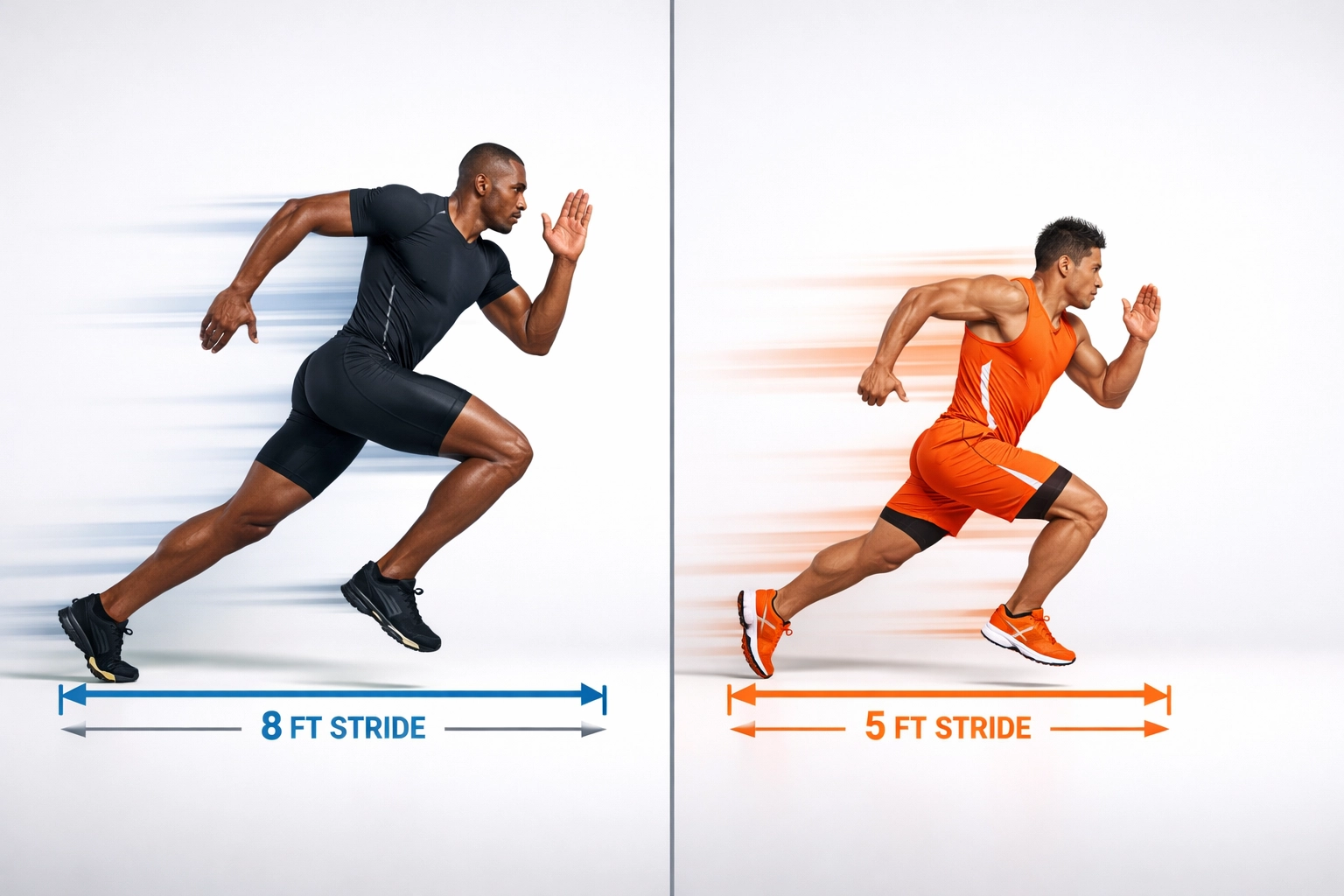
Velocity = Stride Length × Stride Frequency
Most athletes and coaches fixate on one variable: usually frequency, thinking "faster legs = faster times." But this ignores the anthropometric reality: not all bodies are built the same.
Consider the delta between two Olympic titans:
- Usain Bolt (6'5"): 4.3 steps per second × 2.75-meter stride length = fastest human ever
- Christian Coleman (5'8"): 5.0 steps per second × 2.0-meter stride length = world-class speed
If you force a Bolt-type athlete to prioritize turnover, you collapse their stride length and kill their efficiency. If you force a Coleman-type to overreach for length, they lose their reactive "pop" and destroy their contact time.
The application for youth athletes: Stop chasing a universal "step count." Understand your body type. If you're tall and powerful, maximize your stride mechanics and hip extension. If you're shorter and bouncy, focus on reactive strength and ground contact efficiency. One size does not fit all.
Lesson 3: The Dimmer Switch: Why You're Always Training Everything
Traditional coaching operates on a phase-based system: strength in winter, speed in spring, endurance in summer. This is fundamentally flawed. The truth? You're always training all five bio-motor abilities simultaneously. They're never "off": they're just dialed to different intensities.
The five switches:
- Speed
- Strength
- Endurance
- Flexibility
- Coordination
During a technical warm-up, coordination and flexibility are dialed up. During a max-velocity sprint session, speed and strength lead. But here's the kicker: coordination is the most neglected switch in youth development.
High-level sprinting isn't just about being strong or fast: it's about organizing your limbs under extreme force at high speed. If an athlete can't coordinate a proper A-position or maintain alignment through acceleration, their strength and endurance are wasted.
For our athletes preparing for recruiting showcases, this is critical. You can't just "out-tough" poor mechanics. You have to train the nervous system to fire correctly under fatigue.
Lesson 4: Training Age & the Recruiting Gold Mine
In elite recruiting circles, there's a metric more valuable than the stopwatch: training age. This is the cumulative time an athlete has spent in structured, sport-specific training: and it's the key to identifying "diamonds in the rough."
Consider a high school senior from a small Midwest school. Due to climate and multi-sport demands, their track season might only last 12 weeks per year. Over four years, that's one calendar year of actual sprint training. If that athlete is running elite times despite glaring technical issues, limited facilities, and no private coaching, they're a gold mine. Their genetic ceiling is untapped.
Compare that to a year-round club athlete with professional coaching since middle school. They might be running similar times, but they're already maximized. There's no upside.
The lesson for parents and coaches: Stop chasing the finished product. Find the athlete performing well despite their circumstances, not because of them. That's where the developmental upside lives.
At Boardwalk Beasts, we see this constantly in our camp evaluations. The kid from the small school with the 4.6 forty and poor technique? That's a future 4.4 athlete with proper coaching.
Lesson 5: Newton's Third Law: The Physics of the Start
Elite acceleration is governed by a simple physics principle: for every action, there is an equal and opposite reaction. The direction of force you apply to the ground dictates where your body mass is projected.
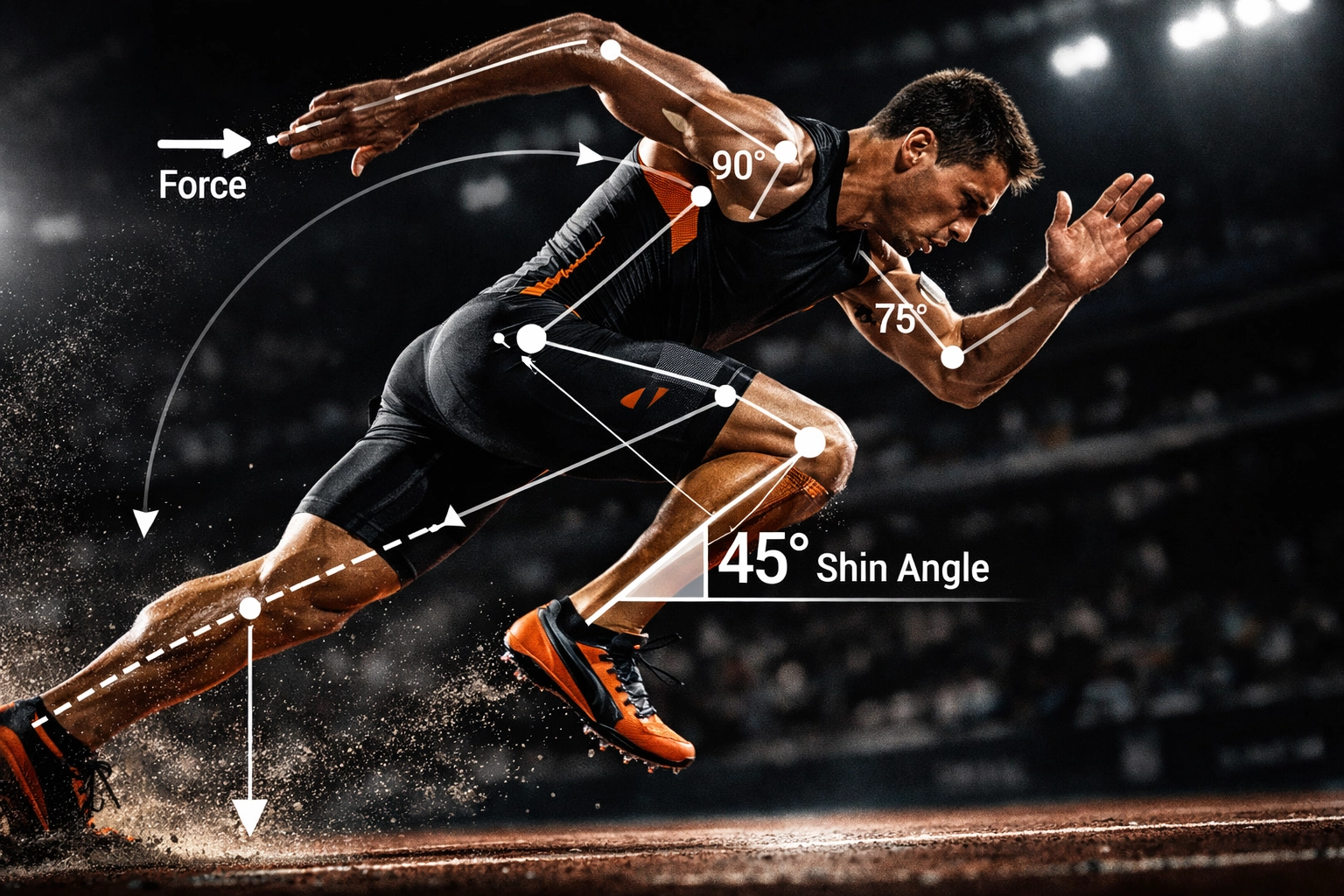
Here's the problem: most athletes are vertical at the start. If your shin is at a 90-degree angle when you explode out of your stance, the force travels straight up. You're not accelerating: you're jumping.
The fix: a 45 to 50-degree shin angle. This allows force to travel through the angle of the bone, driving your center of mass forward rather than upward. Precision matters here because we're talking about milliseconds. Elite ground contact time is roughly 0.08 seconds; developmental athletes sit at 0.12 seconds. That 0.04-second delta is the difference between a scholarship offer and a "thanks for coming out."
For football athletes, this translates directly to your three-cone, your pro agility, and your ability to explode off the line. Check out our wide receiver drill breakdowns to see how we apply these mechanics to position-specific movements.

Lesson 6: Icing vs. Cake: Stop the Biohacking Nonsense
The modern performance landscape is cluttered with "biohacks": pool-based twitch drills, resistance ropes, over-speed treadmills, and every gadget promising to shave 0.1 off your forty time. Here's the reality: these are the icing, not the cake.
Sprinting is Central Nervous System (CNS) work. It relies on the ATP-CP energy system, which requires massive rest-to-work ratios to maintain quality. If an athlete cannot strike the ground correctly at their natural top speed, pulling them faster with a machine only teaches them to brake by over-striding.
As Parno puts it: "I see some people doing over-speed and it's like, 'Bro, you don't even know how to sprint yet.' Over-speed is trying to get to the end of the book before we've read it all."
Foundation first: Master the A-position. Drill ground contact mechanics. Build reactive strength. Then: and only then: consider the biohacks.
The Player-Led Standard: Individualization is the Future
The era of militant, one-size-fits-all coaching is dead. The future is health, efficiency, and individualization. We must distinguish between two athlete archetypes:
- The Elastic Athlete: Wiry, bouncy, thrives on reactive plyometrics and high-frequency contacts
- The Freight Train: Powerful, takes longer to build momentum, but possesses immense top-end force
Treating them the same is a recipe for injury and stalled development. By prioritizing movement quality and individualizing training loads, we ensure the athlete who starts the season is the same one finishing the championship run.
At Boardwalk Beasts, this philosophy drives everything we do: from our youth camps to our elite 7v7 teams. We're not interested in breaking athletes down. We're interested in building them correctly.
Final Question: If your current training focuses on how much you can endure rather than how well you can move, are you building a foundation: or just waiting for the house to fall down?
Ready to train smarter? Explore our full program offerings and film evaluation services to see where your athlete's true ceiling lives. The stopwatch doesn't lie; but it also doesn't tell the whole story.
About Author
