
GAME-SPEED PATTERN RECOGNITION MANUAL: How WRs, DBs & RBs Read, React, Move & Accelerate in Real Time
Game speed separates elite football players from the rest of the pack. It's not about who runs the fastest 40-yard dash – it's about who processes information faster, reads patterns quicker, and executes movements with precision under pressure. At Boardwalk Beasts Football Club, we understand that true game speed comes from the brain's ability to instantly detect movement cues and select the correct biomechanical response.
What Game-Speed Pattern Recognition Really Is
"Game speed" isn't max velocity. It's a complex system involving what you see, how you interpret movement, how quickly you select the right pattern, and how fluidly your body executes it.
Elite players don't think during plays – they recognize → initiate → explode. This is neural intelligence applied directly to football, where the speed of the entire cognitive-physical system determines success on the field.
Game-speed pattern recognition equals the brain's ability to instantly detect movement cues and trigger the correct biomechanical response faster than opponents can react.
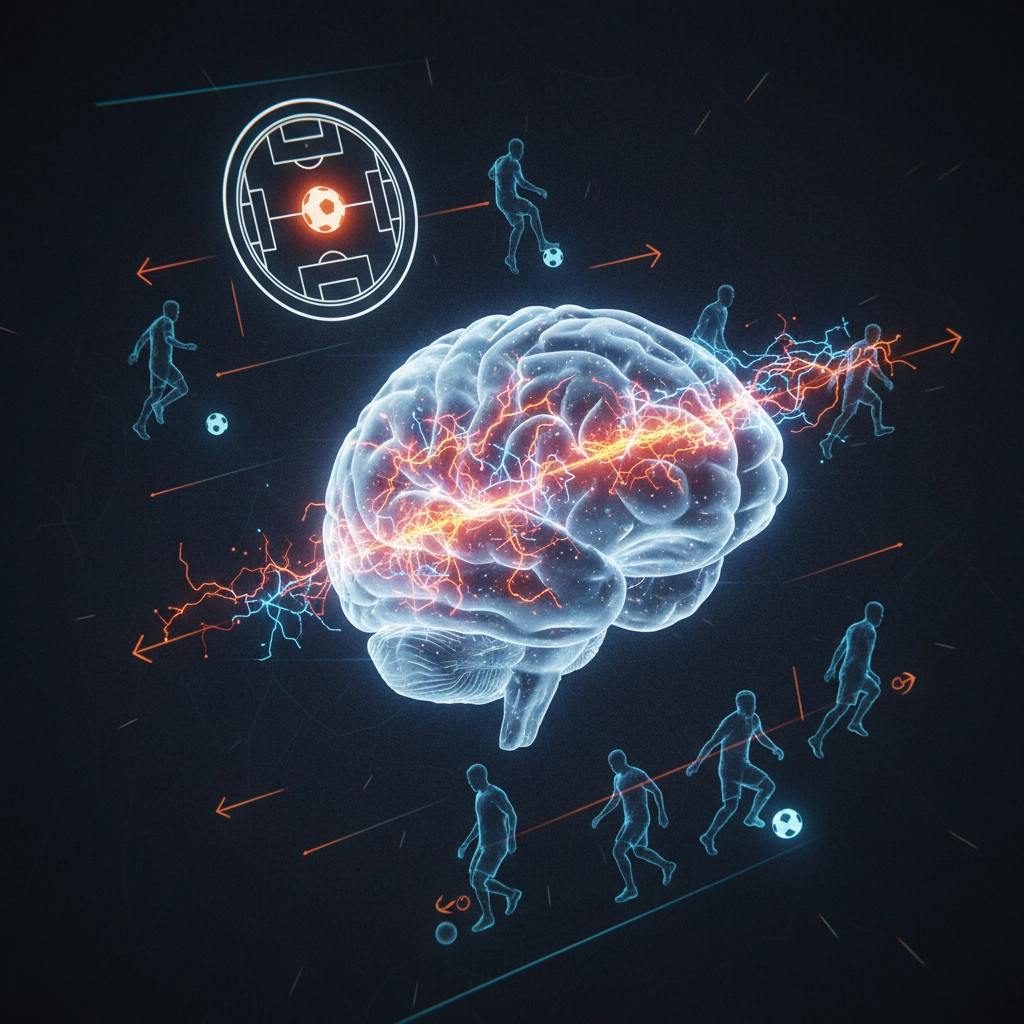
The Three Layers of Game-Speed Pattern Recognition
Understanding game speed requires breaking down the recognition process into three distinct layers that work simultaneously during live play.
Layer 1: Visual Recognition
What elite players perceive in real-time:
- Angles – Body positioning and directional indicators
- Leverage – Spatial advantages and disadvantages
- Hip position – The most reliable predictor of movement direction
- Body weight shift – Center of mass changes that signal intent
- Space availability – Open areas and collision zones
- Opponent rhythm changes – Tempo shifts that reveal strategy
Layer 2: Cognitive Interpretation
What the brain decides based on visual input:
- Where space will open in the next 1-2 seconds
- Where opponents will move next based on current positioning
- When to accelerate, decelerate, or redirect movement
- Which biomechanical pattern matches the situation
Layer 3: Biomechanical Output
How the body executes the cognitive decision:
- Shin-angle changes – Directional adjustments
- Hip-flip efficiency – Transitioning between movements
- Deceleration to acceleration transitions – Speed control
- Elastic steps and posture control – Maintaining efficiency
Game speed represents the speed of this entire integrated system working in harmony.
Position-Specific Pattern Recognition
Each position reads different cues and executes different responses, but the underlying principles remain consistent across all positions.
Wide Receiver (WR) Pattern Recognition
Elite wide receivers read defenders the same way quarterbacks read coverage – they're processing multiple data streams simultaneously to create separation.
WR Visual Reads:
- Defensive back leverage and positioning
- DB hip orientation (open/closed)
- Defender stride rhythm and cadence
- Cushion distance measurements
- Safety rotations and help coverage
- Linebacker depth on crossing routes
These visual cues determine critical execution factors:
- Release style – How to get off the line
- Stem speed – Tempo of the initial route portion
- Break angle – Sharpness and timing of direction changes
- Re-acceleration timing – When to explode out of breaks
WR Biomechanical Reactions:
✓ Adjusting stem angle based on leverage
✓ Altering stride cadence to manipulate timing
✓ Delaying or accelerating breaks based on coverage
✓ Snapping hips efficiently when defenders commit
✓ Maintaining posture control during physical engagement
WR game speed formula: Pattern-read → Route-timing → Biomechanical execution
Defensive Back (DB) Pattern Recognition
Defensive backs must mirror and predict receiver patterns while maintaining proper positioning for run support and deep coverage.
DB Visual Reads:
- Wide receiver hip positioning (the ultimate key)
- WR stride rhythm changes (acceleration/deceleration cues)
- Receiver pad level and posture
- WR tempo variations during routes
- Receiver eye-line and head positioning
- Quarterback shoulder tilt and release timing
- Formation splits and alignment indicators
DB Biomechanical Reactions:
✓ Hip flip execution based on vertical threat assessment
✓ Backpedal cadence adjustment to match receiver tempo
✓ Leveraging sideline and help coverage
✓ Transition timing from pedal to sprint
✓ Re-acceleration angles for recovery coverage
✓ Under/over-breaking routes based on tempo recognition
DB game speed formula: Read → Anticipate → Biomechanical reaction → Re-acceleration
Defensive backs who "see the route" developing earlier can move faster with significantly less physical effort.
Running Back (RB) Pattern Recognition
Running back pattern recognition involves navigating controlled chaos – reading multiple defenders while processing blocking scheme development in real-time.
RB Visual Reads:
- Defensive line flow and penetration patterns
- Linebacker scrape paths and fill techniques
- Safety depth and run support angles
- Second-level defender leverage
- Distinction between penetration versus wash blocks
- Cutback lane development
- Space creation by offensive line
RB vision equals recognizing patterns within collapsing space while maintaining forward progress.
RB Biomechanical Reactions:
✓ Lateral-to-linear transition efficiency
✓ Elastic deceleration when entering traffic
✓ Sharp angle cuts without losing momentum
✓ Posture maintenance through contact
✓ Explosive burst acceleration when lanes appear
✓ Shin-angle redirection for optimal path selection
RB game speed formula: Perception → Redirection → Burst
Elite running backs aren't guessing – they're processing defensive patterns faster than defenders can adjust to their movements.
The Biomechanics of Effective Pattern Recognition
Pattern recognition becomes meaningless without proper biomechanics to execute the chosen response. The nervous system must translate recognition into efficient movement.
Posture Dictates Response Speed
High-hip, tall posture enables:
- Better acceleration mechanics
- Quicker direction change capability
- More efficient leg cycling
- Reduced energy waste
Collapsed posture slows every aspect of movement execution.
Shin Angle Determines Movement Direction
The shin angle reveals exactly where an athlete is moving before their feet demonstrate the change. Elite players shift shin angles instantaneously based on pattern recognition.
Elastic Stiffness Controls Reaction Speed
Higher elastic stiffness equals less ground contact sink, which produces faster rebound and quicker reactions to stimuli.
Coordination Ensures Execution Precision
Chaotic game situations require:
- Clean movement sequencing
- Efficient timing between body segments
- Seamless rhythm changes
- Relaxed execution under pressure
This explains why relaxed athletes consistently react faster than tense competitors.
Universal Pattern Recognition Cues
Regardless of position, all elite football players read these fundamental movement cues:
1. Hip Position
Hips never lie – they indicate direction before feet move. Hip orientation provides the most reliable predictor of opponent intent.
2. Tempo Changes
Sudden slowing or acceleration signals breaks, cuts, or vertical routes. Tempo is the universal language of deception in football.
3. Stride Rhythm
Cadence changes reveal intent before obvious directional changes occur. Elite players feel rhythm disruptions immediately.
4. Center of Mass Shifts
Does the opponent rise? Lower? Shift laterally? Center of mass changes predict the next movement phase.
5. Shoulder Angle
Shoulder positioning precedes acceleration or deceleration decisions. It's the bridge between cognitive decision and physical execution.
Elite football athletes process these cues subconsciously, allowing conscious focus on strategy and technique execution.
Movement IQ Integration
Pattern recognition feeds directly into Movement IQ – the ability to choose optimal movement solutions at precisely the right moment.
Elite Movement IQ manifests as:
- Deion Sanders anticipating route breaks before they happen
- Cooper Kupp adjusting route tempo mid-pattern based on coverage
- Tyreek Hill manipulating defensive backs with speed changes
- Christian McCaffrey timing cutbacks with perfect precision
- Jalen Ramsey undercutting routes through superior anticipation
Movement IQ represents the combination of neural processing speed and biomechanical execution excellence.

The Six Laws of Game-Speed Pattern Recognition
These fundamental laws govern elite pattern recognition in football:
Law 1: The body moves only as fast as the brain recognizes patterns
Law 2: Hips reveal direction earlier than any other body part
Law 3: Smooth rhythm changes beat forced explosiveness
Law 4: Posture dictates reaction speed capability
Law 5: Elastic re-acceleration wins after every recognition phase
Law 6: Movement IQ transforms raw speed into game speed
These laws define the difference between athletic potential and competitive performance.
Developing Game-Speed Recognition
At Boardwalk Beasts Football Club, we integrate pattern recognition training into every aspect of player development. Our skill development programs focus on building the neural-physical connection that produces elite game speed.
Game speed isn't about training harder – it's about training smarter. When players understand what to look for and how to react efficiently, their natural athletic ability amplifies significantly.
The Competitive Edge
Elite wide receivers, defensive backs, and running backs share one crucial advantage: their brains process patterns before opponents even initiate movement. This cognitive head start, combined with efficient biomechanical execution, creates the appearance of "effortless" play that separates elite performers from the competition.
Game-speed pattern recognition equals recognition → decision → biomechanical execution, executed faster than opponents can process and respond.
Understanding these principles gives Boardwalk Beasts players the mental framework to maximize their physical tools and dominate at every level of competition.
About Author
