
PortalIntel.AI Transfer Watch: Elite QBs Sam Leavitt & Byrum Brown Eye Miami as Next Stop
Ready to develop elite quarterback skills like these college stars? Check out our QB/WR Elite Series and visit Boardwalk Beasts Football Club for competitive youth programs that build championship-level fundamentals.
The college football transfer portal has become a high-stakes chess match, and the University of Miami Hurricanes are positioning themselves to make aggressive moves for elite quarterback talent. With Carson Beck's departure creating a massive void under center, Miami's coaching staff has identified two premier signal-callers who could transform their offensive trajectory: Arizona State's Sam Leavitt and USF's dual-threat dynamo Byrum Brown.
According to PortalIntel.AI's latest intelligence, both quarterbacks represent the type of game-changing talent that could elevate Miami's championship aspirations. The Hurricanes aren't just window shopping: they're leveraging significant NIL resources and program prestige to compete with powerhouse programs for these elite prospects.
Sam Leavitt: The Proven Portal Prize

Arizona State quarterback Sam Leavitt has emerged as arguably the most coveted signal-caller remaining in the transfer portal following Brendan Sorsby's commitment to Texas Tech. His 2025 campaign speaks volumes about his readiness for the next level: 2,885 passing yards, 24 touchdowns, and just 6 interceptions across 13 starts.
Those numbers tell the story of a quarterback who has mastered the art of taking care of the football while consistently moving the chains. Leavitt's touchdown-to-interception ratio of 4:1 demonstrates the type of decision-making that separates elite quarterbacks from merely good ones. For youth players studying the position, this ratio represents the gold standard of quarterback efficiency.
Miami enters Leavitt's recruitment as what insiders are calling a "dark horse" contender, competing directly with Tennessee and LSU for his commitment. While the Volunteers and Tigers may have geographic advantages, Miami possesses something equally compelling: substantial NIL resources and a proven track record of developing quarterbacks for the next level.
The Hurricanes' offensive coordinator Shannon Dawson has built a reputation for maximizing quarterback talent through innovative schemes that emphasize both precision passing and explosive playmaking. Leavitt's skill set: characterized by accurate intermediate throws and exceptional pocket presence: aligns perfectly with Dawson's system requirements.
What makes Leavitt particularly attractive isn't just his statistical production, but his leadership qualities. Starting 13 games as a junior demonstrates the trust Arizona State's coaching staff placed in his decision-making abilities. For young quarterbacks learning the position, this type of consistency and reliability should serve as a blueprint for development.
Byrum Brown: The Dual-Threat Difference-Maker
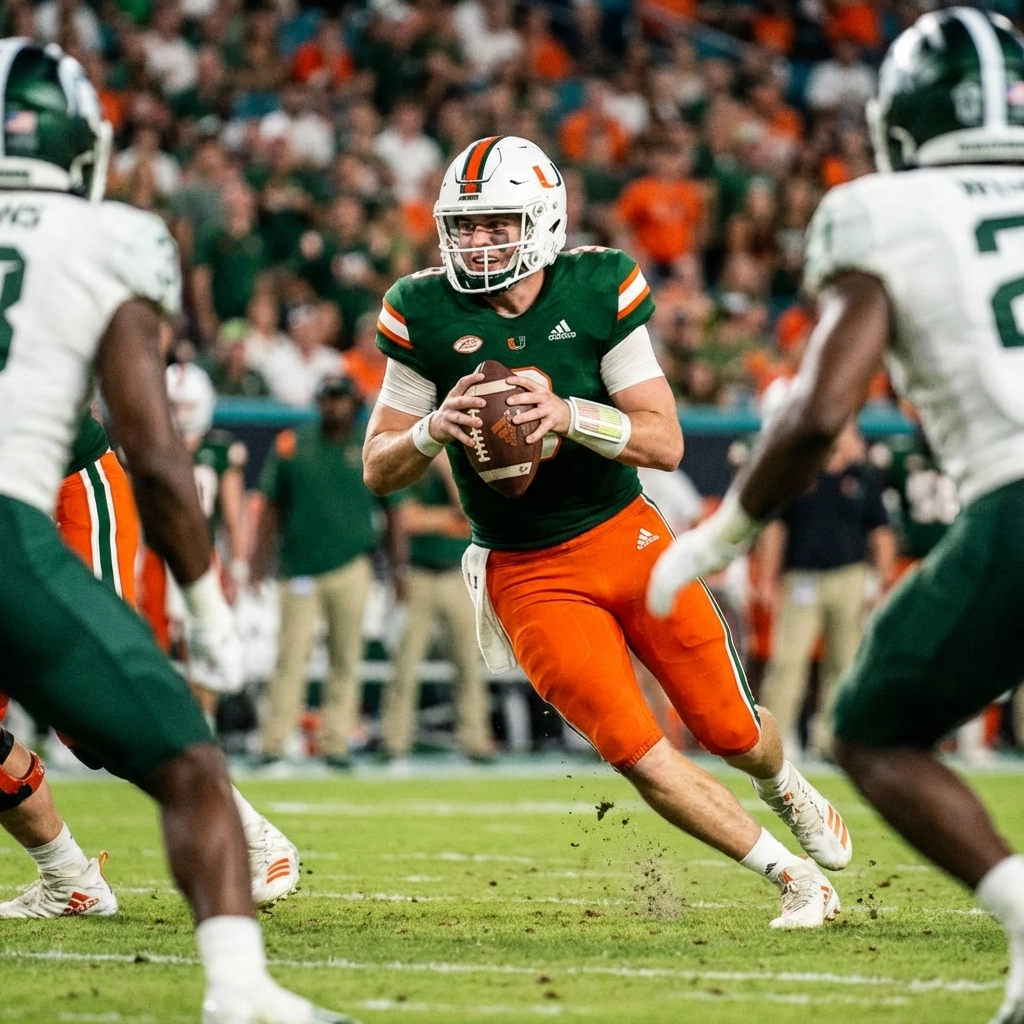
While Leavitt represents pocket-passing excellence, South Florida's Byrum Brown brings a completely different dimension to quarterback play. His 2025 season numbers read like a video game simulation: 3,158 passing yards, 28 passing touchdowns, 1,008 rushing yards, and 14 rushing touchdowns. Combined, Brown accumulated over 4,000 total yards of offense: a staggering achievement that places him among the nation's elite dual-threat quarterbacks.
Brown's rushing production adds a layer of unpredictability that modern defenses struggle to contain. His 1,008 rushing yards represent more than many starting running backs accumulate in a full season. This ground-game threat forces defensive coordinators to account for an additional player in the backfield, opening opportunities for receivers and creating favorable matchups throughout the offense.
Miami's pursuit of Brown intensifies due to several strategic advantages. His representation reportedly maintains strong ties to the Hurricane program, providing Miami with valuable insider access during the recruitment process. Additionally, the Hurricanes possess the financial firepower necessary to match Brown's high market valuation, though they face fierce competition from Auburn.
The Auburn Tigers have emerged as Miami's primary competition for Brown's services, setting up a recruiting battle between two programs with rich football traditions and substantial NIL capabilities. This competition underscores Brown's value as a transformational talent capable of immediately upgrading any program's offensive potential.
For youth football coaches and players, Brown's development path offers crucial insights. His ability to excel as both a passer and runner didn't happen overnight: it required years of dedicated training in multiple skill areas. Young quarterbacks should focus on developing arm strength, accuracy, footwork, and running mechanics to create similar versatility.
Strategic Implications for Miami's Championship Pursuit

The Hurricanes' aggressive pursuit of both quarterbacks reflects a program unwilling to settle for mediocrity at the sport's most important position. Losing Carson Beck created an immediate need for veteran leadership and proven production: qualities both Leavitt and Brown possess in abundance.
Miami's coaching staff understands that successful programs in today's college football landscape must leverage the transfer portal strategically. Rather than relying solely on recruiting high school prospects and hoping for multi-year development, elite programs identify proven college performers who can contribute immediately.
The timing of these potential acquisitions couldn't be more critical. Miami enters the 2026 season with championship expectations and offensive talent capable of competing with anyone nationally. Adding either Leavitt or Brown would provide the final piece needed to challenge for conference titles and playoff positioning.
From a schematic perspective, both quarterbacks offer Miami's offensive coordinator maximum flexibility. Leavitt's pocket-passing skills would complement the Hurricanes' existing receiving corps perfectly, while Brown's dual-threat abilities would add an entirely new dimension to the offensive playbook.
Lessons for Youth Football Development
The recruitment of Leavitt and Brown provides valuable insights for young players aspiring to reach similar levels. Both quarterbacks followed different development paths but shared common characteristics: consistency, leadership, and continuous improvement.
Visit My Football Camps to develop the fundamental skills that college coaches demand, and explore our recruiting programs designed to maximize your exposure to college scouts.
Leavitt's journey emphasizes the importance of mastering traditional quarterback fundamentals: footwork, pocket presence, and decision-making. His 4:1 touchdown-to-interception ratio didn't happen by accident: it resulted from countless hours of studying film, understanding defensive concepts, and making smart choices under pressure.
Brown's path highlights the value of diversifying skill sets. His ability to hurt defenses through both passing and rushing creates multiple ways to impact games. Young quarterbacks should focus on developing both throwing and running abilities rather than limiting themselves to a single style.
Both players demonstrate that consistent production over multiple seasons matters more than spectacular single-game performances. College coaches value reliability and steady improvement over flashy statistics that don't translate to winning football.
The NIL Factor and Modern Recruiting
The pursuit of Leavitt and Brown also illustrates how Name, Image, and Likeness opportunities have transformed college football recruiting. Miami's significant NIL resources provide competitive advantages that extend far beyond traditional scholarship offerings.
For young athletes and their families, understanding the NIL landscape becomes increasingly important for maximizing opportunities. Programs like Miami can offer financial packages that include endorsement deals, social media partnerships, and business development opportunities alongside traditional education benefits.
This evolution in college athletics creates new pathways for talented players to benefit from their abilities while pursuing education and athletic development. However, it also increases competition for roster spots, making fundamental skill development more crucial than ever.
Looking Ahead: Championship Implications
Should Miami successfully land either quarterback, the ripple effects would extend throughout college football. The Hurricanes possess offensive weapons capable of competing with any program nationally, but lacked the proven quarterback leadership necessary for championship runs.
Leavitt's addition would provide immediate stability and veteran leadership, allowing Miami's explosive receiving corps to maximize their potential. His decision-making abilities and pocket presence would create opportunities for big plays while minimizing costly turnovers.
Brown's commitment would transform Miami's offensive identity entirely, adding a rushing dimension that few defenses could adequately prepare for during a single game week. His dual-threat capabilities would stress defensive coordinators and create favorable matchups throughout the offensive formation.
Either acquisition positions Miami as a serious contender for ACC championships and College Football Playoff berths. The combination of elite quarterback play, proven offensive weapons, and strong defensive talent creates the foundation for sustained excellence.
Ready to start your journey toward college football success? Explore our comprehensive training programs at My Football Camps, connect with Coach Schuman at coachschuman.com, and follow the Boardwalk Beasts at boardwalkbeastsfb.com for the latest in competitive youth football development.
Source: PortalIntel.AI
About Author
