
Portal Intelligence: The Big Men Dominating the Late Cycle (Feb 12 Update)
Before you dive in: Understanding the recruiting arms race at the college level helps frame your own pathway. Whether you're a parent evaluating programs or an athlete building your recruiting strategy, the lessons from elite-level roster construction apply at every tier. Explore proven recruitment strategies and film evaluation services at myfootballcamps.com and boardwalkbeastsfb.com.
The War for the Trenches Never Stops
The primary NCAA transfer portal window slammed shut in mid-January, but the intelligence reports coming out of the late cycle tell a different story: the battle for elite interior defensive linemen is still raging. While the majority of the market has settled, the true difference-makers: the plug-and-play defensive tackles who can collapse a pocket and anchor a run defense: are still taking visits, weighing NIL packages, and flipping commitments.
This isn't the bargain bin. This is where programs with serious championship aspirations separate themselves. College Football Playoff participants like Miami and Indiana are seeing roster attrition. Graduate transfers are exercising their additional flexibility. Coaching changes have triggered a secondary wave of movement. The result? A handful of elite interior defensive linemen are dictating the final chapter of the 2026 cycle.
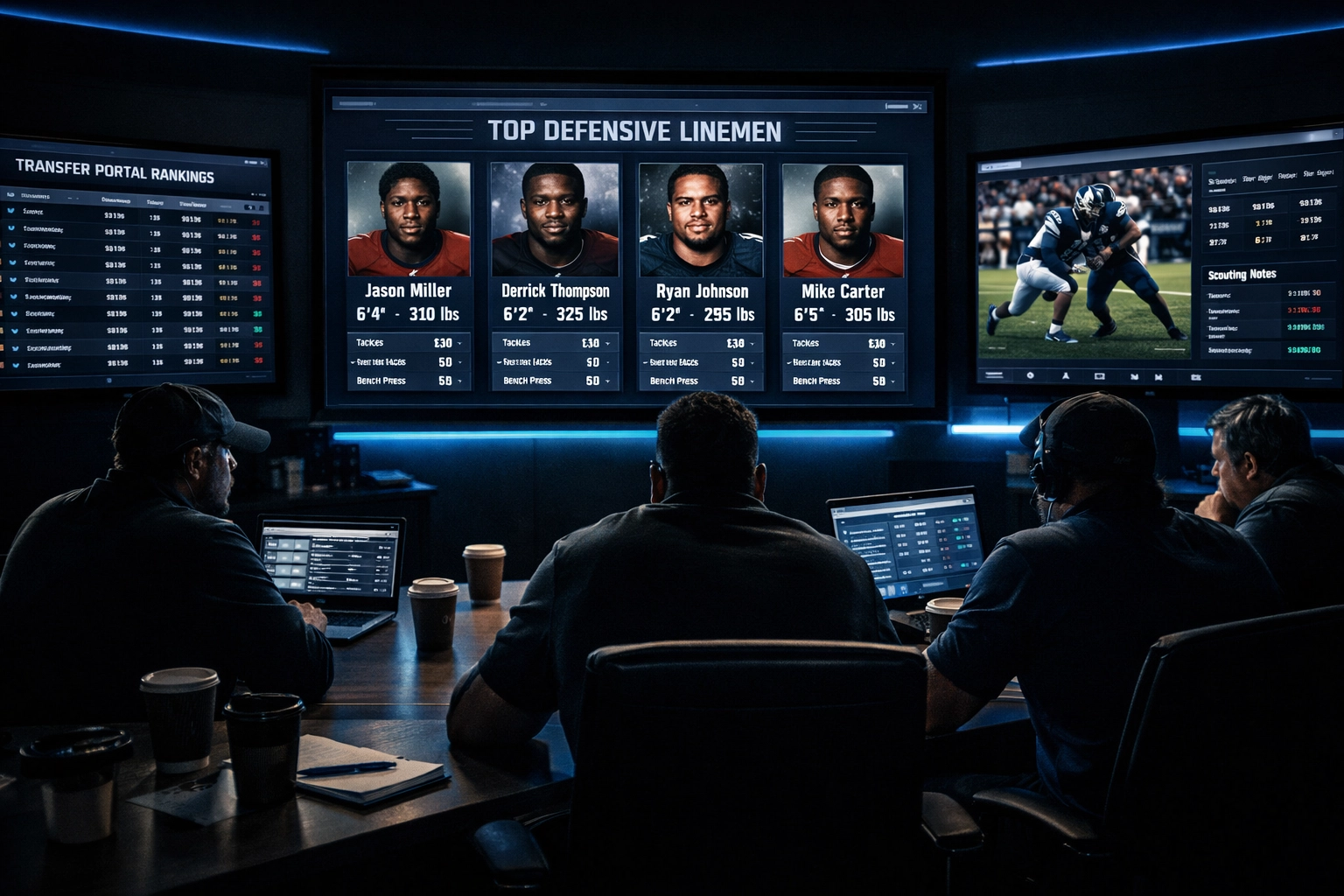
For those tracking the arms race, here's your scouting report on the big men still dominating the board as of February 12.
The Elite Tier: Million-Dollar Bodies and Game-Wrecking Potential
Mateen Ibirogba (Wake Forest) – The $1M Plug-and-Play
When On3 ranks you as the #1 interior defensive lineman in the entire portal cycle, you aren't just a prospect: you're a market-mover. Ibirogba checks every box a defensive coordinator dreams about: 6'3", 296 lbs of power with the technical refinement of a three-year ACC starter. His recent visit circuit: Texas Tech, Notre Dame, Tennessee: reads like a who's who of programs loading up for playoff runs.
His reported NIL valuation hovers near $1 million, and it's justified. Ibirogba isn't a developmental project; he's a day-one starter who can two-gap against the run and generate interior pressure on passing downs. Programs aren't bidding for potential: they're bidding for proven production. His film shows consistent hand usage, exceptional leverage despite his height, and the kind of motor that defensive line coaches build entire schemes around.
Santana Hopper (Tulane) – The Pass-Rush Tweener
At 265 lbs, Hopper is undersized by traditional defensive tackle standards, but his statistical profile tells you everything you need to know: 10.5 TFLs and 4.5 sacks in a single season. He's not a space-eater; he's a penetrator. In defensive systems that prioritize interior pass rush and run high-stunt packages, Hopper is the premier name in the portal.
His quickness off the snap is elite-tier. He wins with first-step explosiveness and the ability to split double teams before offensive linemen can establish their base. Power 4 programs are circling because Hopper represents a specific archetype: the interior disruptor who can operate in sub-packages and provide the kind of pass-rush versatility that modern offenses struggle to account for.
Ezra Christensen (New Mexico State) – The Win-Rate King
Statistical darlings don't always translate to the next level, but Christensen's metrics are impossible to ignore. He finished the 2025 season in the top 10 nationally for pass-rush win rate among interior defensive linemen. That's not a fluke: that's a clinical demolition of offensive lines week after week.
Christensen logged 11.0 TFLs by combining raw power with a deceptively quick first step. Scouts view him as a high-floor, high-ceiling prospect who thrived in a Group of Five environment but possesses the physical tools to make an immediate impact in a Power 4 conference. Programs looking for interior pressure without sacrificing gap integrity are prioritizing Christensen as a late-cycle steal.

Oregon's Trench Warfare: Dan Lanning's Big Ten Blueprint
If there's a single program that has weaponized the late portal cycle, it's Oregon. Dan Lanning is orchestrating a defensive line rebuild that looks less like roster management and more like strategic stockpiling. With the Ducks' entry into the Big Ten, the mandate is clear: you cannot survive the physical gauntlet of that conference without elite size and depth in the trenches.
Derrick Brown Jr. (Howard to Oregon)
At 6'5", 295 lbs, Brown brings 16 games of starting experience and two years of eligibility. This isn't a speculative depth piece: this is an immediate contributor who can rotate in from day one. Lanning's staff identified Brown as a player who could make the jump from the FCS level to the Power 4 and handle the physicality of Big Ten offensive lines.
D'Antre Robinson (North Carolina to Oregon)
Robinson is the definition of imposing: 6'4", 315 lbs of mass designed to occupy multiple blockers and create one-on-one opportunities for edge rushers. His addition directly addresses Oregon's portal departures. Robinson isn't flashy, but he's the kind of "dirty work" player who makes everyone around him better by commanding double teams and freeing up linebackers to flow to the ball.
Jerome Simmons (ULM to Oregon)
A 340-lb veteran nose tackle, Simmons represents pure depth insurance. In a 16-game Big Ten schedule, attrition is inevitable. Lanning is betting that Simmons' size and experience make him a plug-and-play rotational piece who can absorb snaps in run-heavy packages and keep fresher bodies available for critical late-game situations.
Oregon's strategy is transparent: build a defensive line rotation so deep that no single injury derails the season. It's an arms race response to the physical realities of their new conference.

The Specialists: Niche Roles, Elite Value
Not every portal addition is designed to start. Some of the most valuable acquisitions are specialists: players who fill a specific schematic need or provide rotational depth in situational packages.
John Walker (UCF) – The Run-Stuffer
Walker isn't a pass-rush specialist, but in run-heavy conference matchups, he's gold. His ability to consistently command double teams and clog interior running lanes makes him a priority for programs that face traditional, ground-and-pound offenses. Walker's film shows a player who wins with positioning and power, not flash. For defensive coordinators installing a 4-3 base, Walker is the kind of "lunch pail" player who never shows up on the stat sheet but makes the defense function.
Ian Geffrard (Arkansas) – The 387-Lb Space Eater
Geffrard is a true nose tackle in every sense. At 387 lbs, he's designed for one job: occupy space and force offenses to account for his mass on every snap. He's ideal for 3-4 defenses looking for a player who can anchor the A-gaps and free up linebackers to make plays. Geffrard won't generate sacks, but his value is measured in the negative plays he prevents by forcing offensive lines to dedicate multiple blockers to his side of the line.
Enow Etta (Michigan) – The High-Pedigree Project
Etta entered the portal as a former top-15 defensive line recruit who never fully unlocked his potential at Michigan. At 320 lbs, he has the physical tools to be dominant, but his technique needs refinement. For a program with an elite defensive line coach and the patience to develop him, Etta represents a high-upside gamble. The raw materials are elite: it's just a matter of finding the right system to maximize them.
What Today's Activity Tells Us
February 12 isn't about new entries: it's about finalizing commitments. The elite names listed above are wrapping up official visits, weighing NIL offers, and making final decisions before spring ball begins. Coaching staffs are operating in "closing mode," leveraging every relationship and resource to land the last pieces of their puzzle.
Because the standard window is closed, today's movement is limited to graduate transfers with additional flexibility and players from programs that underwent coaching changes. The real action is happening behind closed doors: war room discussions, NIL negotiations, and final pitches to prospects who can legitimately alter the trajectory of a program's season.
For programs that missed on their primary targets in January, the late cycle is a lifeline. For programs like Oregon that are aggressively building for conference realignment, it's an opportunity to load up before competitors even realize the market is still active.
The Takeaway: Roster Construction is a Year-Round War
The transfer portal has fundamentally changed the economics of college football. The old model: where recruiting classes were finalized on National Signing Day: is dead. Roster construction is now a continuous cycle of evaluation, negotiation, and strategic addition. The programs that treat the portal as a year-round operation, not a one-time event, are the programs that will dominate the next era of college football.
For those tracking the recruitment arms race, the late-cycle activity in the interior defensive line market is a case study in strategic opportunism. The big men listed above aren't afterthoughts: they're difference-makers. And the programs that land them will have a tangible edge when the season starts.
Ready to build your own recruiting strategy? Whether you're a youth athlete learning the game or a high schooler preparing for the next level, understanding how elite programs evaluate and recruit talent gives you a competitive advantage. Check out our recruiting programs, film evaluation services, and performance training at myfootballcamps.com and connect with Coach Schuman's proven development system at boardwalkbeastsfb.com.
About Author
