
50 Players, One Round Ball: The Chaotic 1869 Birth of American Football
Ready to develop your game in a structured, modern football environment? Check out our programs at myfootballcamps.com and see how far we've come from the chaos of 1869.
Picture this: fifty young men in wool sweaters sprinting across a muddy field, desperately kicking a round ball toward wooden posts while a hundred spectators lean against a rickety fence, screaming encouragement. No helmets. No pads. No forward passes. Just pure, unfiltered chaos.
That was American football in 1869. And honestly? It barely resembled the game we know and love today.
If you've ever watched a perfectly executed play-action pass or marveled at a corner route in 7v7 competition, you owe a debt to the absolute madness that started it all. Let's take a trip back to November 6, 1869, and explore just how wild the birth of America's favorite sport really was.
The 25v25 Mess: Organized Chaos on a College Green
Forget everything you know about football formations. Forget the offensive line, the secondary, the special teams. On that historic fall day in New Brunswick, New Jersey, Rutgers College and the College of New Jersey (now Princeton) each sent 25 players onto the field.
That's right, 50 total players scrambling after a single ball.
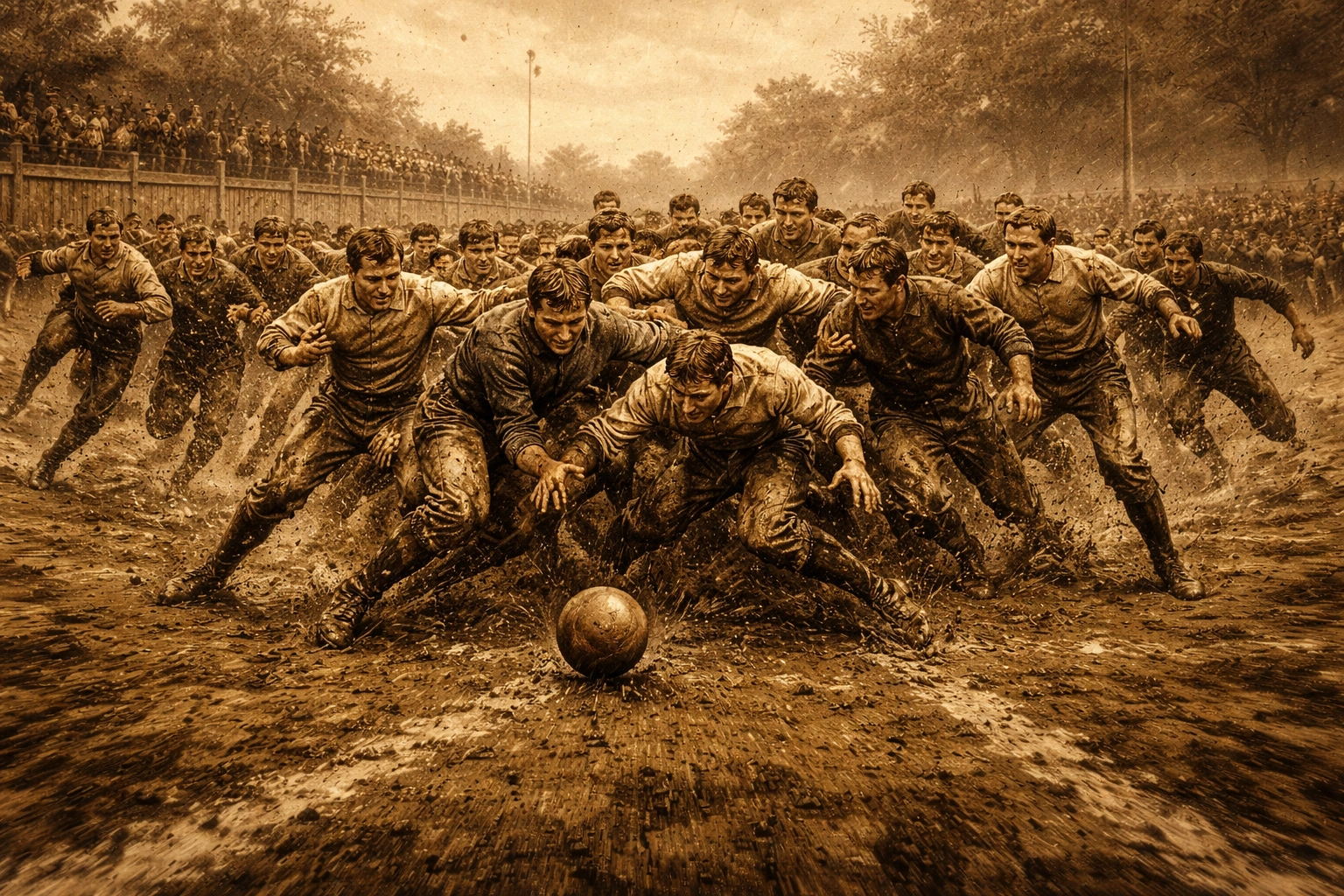
Imagine trying to call a play with 24 teammates. Imagine trying to find open space when there are 49 other bodies crowding the field. The "strategy" was essentially a controlled riot, with waves of students crashing into each other in pursuit of a leather sphere.
The game wasn't a single continuous contest either. It was structured as 10 separate "games," with each goal counting as the end of one game. The first team to win the majority took the match. After each score, the teams switched directions, adding to the general confusion.
To distinguish themselves in the melee, Rutgers students got creative. About 50 of them converted scarlet-colored scarves into turbans, wrapping them around their heads like makeshift uniforms. Princeton players? They just went bareheaded, trusting they'd recognize each other in the chaos.
The final score: Rutgers 6, Princeton 4. The first intercollegiate football game in American history ended with a home victory and absolutely zero forward passes.
Soccer But… Not: A Game Without Carrying or Throwing
Here's where it gets really weird for modern football fans.
In that 1869 game, you couldn't pick up the ball. You couldn't carry it. You definitely couldn't throw it. The rules were a hybrid of English soccer and rugby, created on the spot by the two team captains, William J. Leggett of Rutgers and William Stryker Gummere of Princeton.
The ball itself was completely round, like a soccer ball. The only legal ways to move it were:
- Kicking it toward the opponent's goal
- Batting it with your feet, hands, head, or sides
- Heading it (yes, like soccer)
A "goal" was scored by kicking the ball through the opponent's wooden posts, not by carrying it across a goal line or catching it in an end zone. There were no touchdowns, no field goals, and certainly no two-point conversions.

The game looked more like a massive, violent soccer match than anything you'd see on a Sunday afternoon today. If you dropped a modern quarterback into that 1869 contest, they'd be completely useless, their greatest skill (throwing the ball) was literally illegal.
The Birth of a Rivalry: Rutgers vs. Princeton
Every great sport needs a great rivalry to push it forward. American football was no different.
The Rutgers vs. Princeton matchup wasn't just the first intercollegiate football game, it was the spark that ignited an entire sport. The intensity of that first contest, with 100 spectators pressed against a low wooden fence, created immediate demand for a rematch.
One week later, the two teams met again at Princeton. This time, Princeton won, evening the series. The back-and-forth created something crucial: the need for standardized rules.
When two schools are battling for bragging rights, they can't just make up the rules as they go. They need an agreed-upon framework. This early rivalry forced colleges to sit down and actually decide what "football" was supposed to be.
The game also showcased early strategic innovation. During the 1869 match, a formation called the "flying wedge" emerged, a wall-like structure of players that charged at defenders to protect the ball. When Princeton's taller players gained an advantage, Rutgers captain Leggett adapted, ordering his men to keep the ball low to the ground. That adjustment won them the game.
Even in that primitive era, coaching and strategy mattered. The seeds of the modern game were being planted.
The Walter Camp Revolution: From Chaos to Strategy
The 1869 game was a beginning, but it took another man to truly create the sport we recognize today.
Walter Camp, known as the "Father of American Football," transformed the chaotic kick-fest of the 1870s into a strategic, structured competition. His innovations in the 1880s completely reimagined the game:
- The Line of Scrimmage: Instead of a chaotic scramble, teams would line up facing each other with a clear dividing line.
- The Snap: The center would deliver the ball to the quarterback, creating a defined start to each play.
- Down-and-Distance: Teams had a set number of attempts to advance the ball a certain distance, adding strategic depth.
- 11 Players Per Side: Goodbye, 25v25 chaos. Hello, specialized positions and complex formations.
These changes didn't happen overnight. It took decades of experimentation and rule modifications. The forward pass wasn't even legalized until 1906: nearly 40 years after that first Rutgers-Princeton game.

Think about that timeline. For almost four decades, American football was a running and kicking game. The quarterback as a passer, the concept of a wide receiver, the idea of a passing offense: none of that existed. Walter Camp and his contemporaries had to invent the sport piece by piece.
From 50-Man Scrambles to Precision 7v7
So what does a chaotic 1869 kick-fest have to do with modern youth football development?
Everything.
At Boardwalk Beasts Football Club, we focus on structured development that builds the skills Walter Camp's revolution made essential. Our 7v7 competitions emphasize the precise route-running, accurate passing, and disciplined coverage that define modern football.
The contrast is almost comical. In 1869, fifty guys in wool sweaters kicked a round ball through wooden posts. Today, our athletes run timed routes against tight coverage, develop their footwork in position-specific drills, and learn the strategic nuances that separate good players from great ones.
The evolution from 25v25 chaos to 7v7 precision represents over 150 years of innovation. Every snap, every play call, every formation is the product of countless coaches and players who refined the game generation after generation.
When you step onto the field today, you're not just playing a sport: you're participating in a tradition that started with a group of college students who didn't even know what they were creating.
The Game Never Stops Evolving
American football didn't appear fully formed. It was messy, weird, and barely recognizable. It evolved through fierce rivalries, brilliant innovators, and decades of rule changes.
And here's the thing: it's still evolving.
The spread offense, the RPO, the read-option: these are all relatively recent innovations that have transformed the sport. Who knows what the game will look like in another 50 years? What seemingly small tweak today might define football in the next century?
One thing's for certain: the journey from that 50-man scramble on a New Jersey college green to the global spectacle we watch every Sunday is one of the greatest stories in sports history.
Ready to be part of football's next chapter? Whether you're developing your skills for high school, college, or beyond, we've got programs designed to take your game to the next level. Visit myfootballcamps.com to explore our camps and showcases, check out boardwalkbeastsfb.com for team updates, or dive into coaching insights at coachschuman.com.
The game has come a long way since 1869. Where will you take it next?
About Author
